Copyright Royalty Distribution vs. Infringement Indemnity…
How California’s SB 942 Could Level the Playing Field


Loading...
Verify on BlockchainHow California’s SB 942 Could Level the Playing Field
The world of content creation has always been a complex web of rights, responsibilities, and revenue. As artificial intelligence increasingly shapes this landscape, the stakes have only increased. California’s recent SB 942, the AI Transparency Act, attempts to bring more clarity to these murky waters. By mandating that generative AI systems disclose the provenance of their content, SB 942 could fundamentally reshape how we think about royalties and copyright infringement.
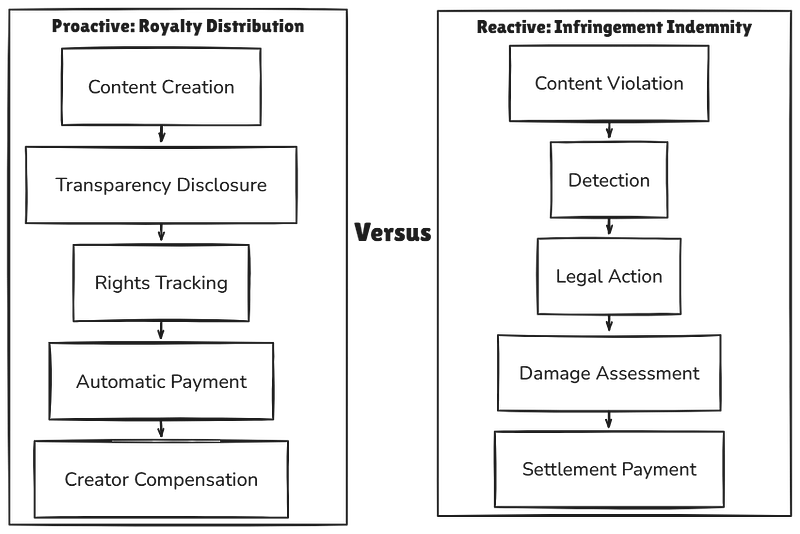
This article will explore how SB 942 could affect two major aspects of copyright law: royalty distribution and infringement indemnities. We’ll explore the mechanics behind both, using Google SynthID as an example of how transparency tools can fail to benefit content creators. Let’s explore how technology and law intersect to protect or neglect artists’ rights.
The Mechanics of Royalty Distribution
Royalty distribution is the money flow from those who use content (like streaming platforms, broadcasters, or advertisers) to those who create it. In the music industry, for example, royalties are paid to various stakeholders — songwriters, performers, publishers, and labels. The process, ideally, ensures that everyone involved in creating a piece of content gets compensated for their contribution.
When you hear a song on a platform like YouTube, you might assume that the artist and everyone involved in the song are being paid appropriately. But the reality is far more complicated. In cases like cross-channel content distribution, particularly on platforms with user-generated content, tracing the origin and usage of a song becomes difficult. This often leads to unpaid or underpaid royalties, especially for songwriters whose works are sampled or repurposed without explicit consent.
In an ideal royalty distribution model, when a song is used, all the relevant rights holders get their cut — whether for a sync license, a performance fee, or mechanical royalties. However, with AI generating and altering content on a massive scale, the lines get blurred quickly. AI tools, such as those used by platforms like YouTube, generate new pieces of content or derive from existing works without always having clear pathways to compensate original creators. This issue is exacerbated by insufficient metadata or lack of proper content tagging, making tracking practically impossible.
Infringement Indemnity: Who Pays for Copyright Violations?
On the flip side of royalties, we have infringement indemnities — who pay when a copyright is violated. Traditionally, when copyrighted content is used without permission, the party responsible for the violation must pay damages to the original rights holder. This might sound straightforward, but accountability is anything but simple in a world with millions of AI-generated and user-uploaded pieces of content.
Platforms like YouTube have long grappled with this issue. Their Content ID system is designed to detect when copyrighted content is used and either share revenue or block it altogether. Yet, this system isn’t perfect. It often falls short of identifying nuanced infringements, particularly when AI generates or transforms content. For instance, a melody generated by an AI could be strikingly similar to an existing copyrighted tune, but if Content ID doesn’t detect the original piece, the rights holders get nothing, and there is no clear path for indemnity.
Google SynthID: The Transparency Without Compensation Problem
Google’s SynthID exemplifies how AI transparency can appear as a self-regulating measure. It is meant to ensure AI outputs are marked and traceable, but it often lacks the depth required to guarantee that creators get fair royalties. For instance, there have been cases where artists discovered that AI models had used their work without compensation despite transparency measures. One notable case involved the estate of Marvin Gaye, which fought to prove that parts of their music were used without permission in AI-generated compositions, highlighting the challenges artists face in holding AI-driven platforms accountable.
While watermarking is a useful tool for tagging AI-generated content, it lacks mechanisms for ensuring that those whose works have influenced the content receive their fair share. Google could, for instance, integrate an enhanced royalty-tracking system directly into SynthID that automatically notifies and compensates original creators whenever their work is used or adapted by AI models. Like YouTube’s Content ID, SynthID applies a watermark to content generated by its AI models, which can help identify whether something is AI-generated. However, it does little to ensure that songwriters, performers, and other stakeholders are appropriately compensated, especially when content flows across multiple platforms and jurisdictions. The watermark is a transparency measure, but without meaningful mechanisms to enforce proper royalty payments, it’s simply a label without teeth.
SB 942: Leveling the Playing Field?
California’s SB 942, the AI Transparency Act, could change this scenario by requiring clearer provenance for AI-generated content. The law will be enforced through mandatory disclosures that AI developers must embed in their outputs, with oversight from regulatory bodies like the California Department of Consumer Affairs to ensure compliance.
Platforms failing to comply may face penalties, including fines up to $100,000 and restrictions on AI model deployment, thereby creating tangible incentives to adhere to transparency requirements. These penalties would primarily affect large content-hosting platforms, such as social media networks and streaming services, and AI developers who create generative content tools. This specification helps ensure that accountability is targeted where it can have the most significant impact.
The law also mandates that generative AI systems include disclosures in their outputs, ensuring that users and platforms can trace the origin of content. In theory, this transparency makes it easier to identify when an AI tool has used copyrighted material in its training or output generation — information crucial for fair royalty distribution and infringement indemnities.
SB 942 opens the door to a more equitable royalty distribution system by mandating provenance disclosures. If platforms are required to disclose whether AI-generated or influenced content, creators might have a better chance at receiving royalties. For example, if a new AI-generated song contains elements that can be traced back to an original copyrighted piece, SB 942 could facilitate mechanisms for compensating those original rights holders.
The act also affects infringement indemnities by clarifying who is liable when AI-generated content infringes on existing works. By tracking the origins of the AI’s training data, the law can help assign responsibility more effectively. For instance, if an AI model was trained on copyrighted songs without permission and generated content that closely mirrors those songs, the entity responsible for training the model could be liable. This could lead to a fundamental shift in how infringement is handled in the age of AI — moving from the murky, often impossible task of proving intent to a clearer chain of responsibility.
Comparative Analysis: Royalty Distribution vs. Infringement Indemnity
When comparing royalty distribution with infringement indemnity, one key difference stands out: proactivity vs. reactivity. Royalty distribution is a proactive process — it aims to compensate creators as content is used. In contrast, infringement indemnity is reactive — it compensates creators only after a violation has occurred, often through costly legal battles.
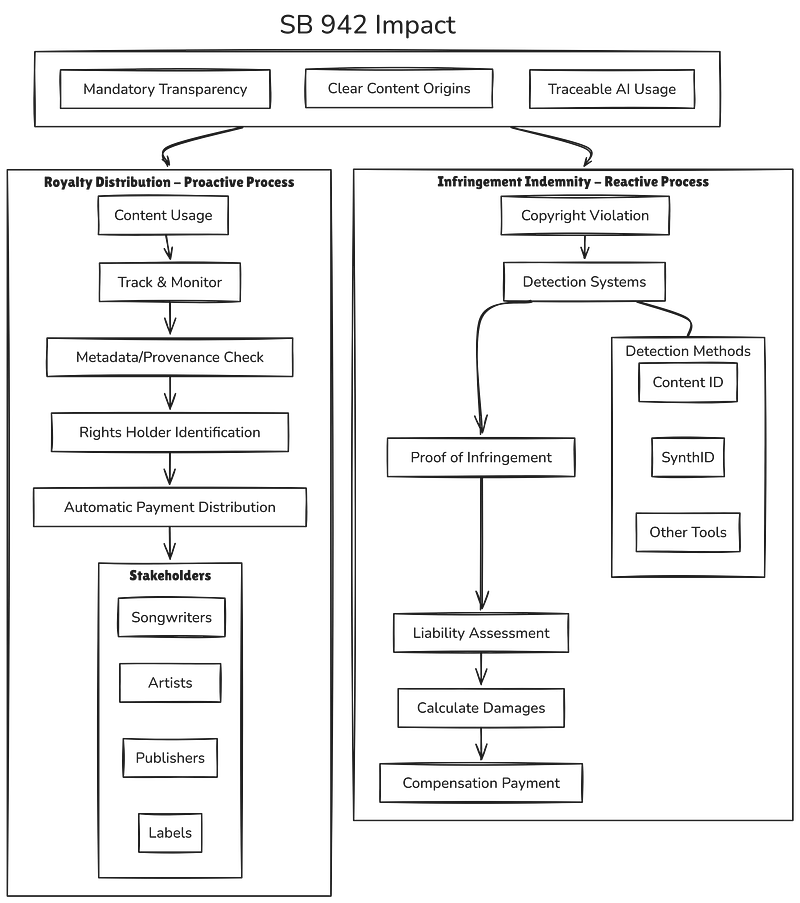
The current systems, such as Content ID or SynthID, tend to favor the reactive model, meaning they address copyright issues only after a violation has occurred rather than preventing misuse from the outset. In contrast, proactive models, such as blockchain-based licensing systems, aim to prevent unauthorized use by ensuring that content is licensed appropriately before use. A proactive model could involve automated licensing agreements generated when an AI system accesses copyrighted material, ensuring compensation before content is released.
SB 942 by mandating clearer disclosures, pushes the system toward more proactivity — ensuring that content creators are acknowledged and paid fairly.
For example, imagine a popular AI-generated remix that blends several existing songs. Without proper transparency, the original songwriters may never see a cent from this remix, despite their work forming the backbone of the new piece. Under SB 942, with required disclosures, these original contributors might have a claim to royalties right from the moment the remix is uploaded — a proactive measure that ensures fair compensation.
On the infringement side, SB 942 could streamline assigning liability. In the case of AI-generated content that infringes on existing works, tracing the training data or influence helps identify responsible parties more directly, reducing the burden on creators to prove infringement occurred. This can also deter platforms from using AI models trained on unauthorized data, knowing the liability will be easier to pinpoint.
Conclusion: Toward a Fairer Digital Content Ecosystem
California’s SB 942 represents a significant step toward addressing the imbalances that have long plagued royalty distribution and infringement indemnities in the digital age. The law clarifies the process by requiring transparency in AI-generated content, ensuring creators are recognized and compensated fairly for their work.
However, tools like Google SynthID highlight a critical gap: transparency without enforcement doesn’t necessarily equate to fairness. Until systems are established that identify AI-generated content and ensure equitable compensation for those whose work has influenced that content, the balance will remain skewed. SB 942 plays a crucial role in addressing this gap by mandating transparency and laying the foundation for fairer compensation practices, ultimately aiming to create a more balanced digital content ecosystem.
Specific systems could include enhanced royalty-tracking mechanisms integrated directly with AI content generators and automated compensation frameworks that use blockchain technology to ensure transparent and fair payments to original creators. For instance, a blockchain-based smart contract system could automatically allocate royalties based on predefined ownership rules, reducing administrative overhead and ensuring timely payments. Additionally, a standardized licensing system for AI training data could be established to help ensure that the content used to train models is properly accounted for and compensated. Similar systems are already in use in the gaming industry, where developers receive automated compensation for in-game assets used by players.
SB 942 might not be a perfect solution. Still, it pushes the conversation forward — toward a digital content landscape where creators, platforms, and AI coexist with greater accountability and equity. As AI continues to play a larger role in content creation, laws like SB 942 are crucial in ensuring technology serves all stakeholders fairly, not just the platforms that develop and deploy it.