CopyrightChains Copyright Registration
A Modern Approach to Protecting Creative Rights

Loading...
Verify on BlockchainA Modern Approach to Protecting Creative Rights
In an era when digital content creation and distribution have reached unprecedented scales, traditional copyright registration and protection mechanisms show their limitations. The emergence of CopyrightChains technology, particularly private blockchain networks dedicated to copyright management, offers a promising solution to these challenges.
How can CopyrightChains registration systems address the critical needs for provenance tracking and immutable record-keeping in the creative industries?
The Current State of Copyright Registration
For example, a photographer might need help to prove ownership of a digital image because the copyright information is spread across various databases, each with different standards and regulations. Additionally, unauthorized copies can easily be altered, further complicating ownership claims.
Traditional copyright registration systems, while functional, face several significant challenges in the digital age. Copyright information is often scattered across multiple databases and jurisdictions, making it difficult to establish clear ownership chains. Proving the authenticity and originality of creative works becomes increasingly complex as digital manipulation tools become more sophisticated. Registering and maintaining copyright records involves substantial paperwork and administrative costs, while significant processing times leave creators vulnerable during the waiting period.
The Power of Blockchain in Copyright Registration
Blockchain technology, particularly private blockchain networks designed specifically for copyright management, offers transformative capabilities through immutable record-keeping and comprehensive provenance tracking. Once registered on the blockchain, copyright information cannot be altered or deleted, with every transaction and transfer of rights permanently recorded. Historical ownership and licensing data remain accessible and verifiable, creating an unbreakable chain of evidence for creative works.
The technology enables clear ownership chains from creation to present, providing transparent records of all rights transfers and licenses. It also tracks derivative works and their relationship to original content. Real-time updates allow for immediate registration of new works and instant recording of rights transfers, ensuring licensing information stays current. Enhanced security through cryptographic protection, distributed storage, and robust verification mechanisms protect the integrity of registration records.
Practical Implementation Benefits
For instance, a musician can use CopyrightChains to immediately register a new song, gaining proof of ownership in minutes instead of waiting through lengthy paperwork. This provides a clear record of rights, making it easier to license the song for commercial use or track any unauthorized use, simplifying monetization and protecting creative rights.
Implementing CopyrightChains copyright registration systems delivers tangible benefits across the creative ecosystem. Creators gain immediate proof of creation and ownership, simplified registration processes, and clear documentation of rights and licenses. The reduced administrative burden allows them to focus more on creative work than paperwork.
Rights holders benefit from a comprehensive view of owned assets and simplified rights management, enabling enhanced tracking of usage and violations. The streamlined licensing processes reduce friction in content monetization. Users and licensees gain easy verification of rights ownership and a clear understanding of available licenses, reducing the risk of accidental infringement while simplifying licensing procedures.
Technical Considerations
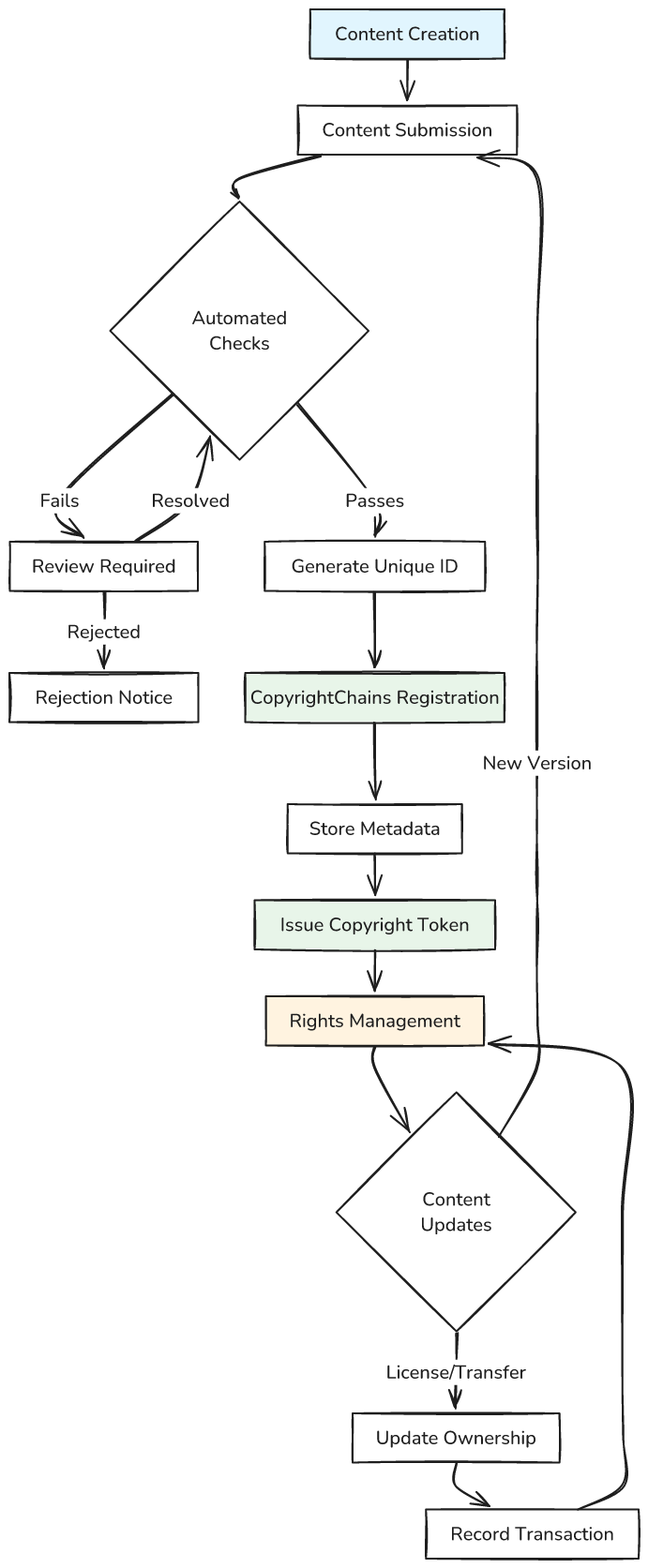
Several technical aspects prove crucial for effective CopyrightChains registration. Implementing international identifier standards and comprehensive metadata frameworks ensures interoperability with existing rights management systems. Smart contract integration enables automated license generation and management, self-executing royalty distributions, and programmable rights transfers.
Quality assessment mechanisms, including automated copyright violation checks, content fingerprinting for originality verification, and AI-powered similarity detection, help maintain the integrity of registered works. For example, content fingerprinting uses unique digital signatures to identify works, while AI-powered similarity detection helps identify potential infringements by comparing new content against existing registrations. These technical capabilities combine to create a robust and efficient system for managing creative rights.
Future Implications
The adoption of CopyrightChains registration systems has far-reaching implications for creative industries. Reduced reliance on intermediaries and more efficient rights management enhance transparency throughout the creative ecosystem. New models for content monetization emerge alongside simplified international licensing opportunities, while reduced transaction costs benefit all participants.
Challenges and Considerations
Despite its advantages, blockchain implementation faces several key challenges. Technical hurdles include developing scaling solutions for high-volume registration, ensuring smooth integration with existing systems, and establishing widely accepted standards. Legal considerations encompass regulatory compliance across jurisdictions, securing legal recognition of blockchain records, and working toward international copyright law harmonization.
Practical implementation challenges involve driving industry adoption and standardization, providing comprehensive user education and training, and managing implementation costs. These challenges require careful consideration and planning to deploy CopyrightChains copyright systems successfully.
Implementation Recommendations
Organizations considering CopyrightChains registration should follow a structured approach to implementation. The assessment phase should evaluate current copyright management processes, identify specific areas for improvement, and assess technical requirements and capabilities. Planning should develop comprehensive implementation strategies, define metadata standards and protocols, and prepare for system integration and migration.
The implementation phase involves deploying blockchain infrastructure, integrating existing systems, and training users and stakeholders. Monitoring and optimization ensure system performance meets requirements, while user feedback drives continuous improvements and updates.
Summary
Blockchain technology offers a robust solution to modern copyright registration and management challenges. By providing immutable records and clear provenance tracking, CopyrightChains systems can significantly improve the efficiency and effectiveness of copyright protection. As the creative industries continue to evolve in the digital age, adopting such systems becomes increasingly important for ensuring the rights of creators and facilitating efficient content monetization.
The future of copyright registration lies in embracing these technological advances while ensuring proper integration with existing legal and business frameworks. Organizations that take steps to implement CopyrightChains registration systems today will be better positioned to manage and protect creative rights in an increasingly digital future. The transformation of copyright registration through blockchain technology represents an evolution in rights management and a fundamental shift in how we protect and value creative works in the digital age.