Limitless Learning, Limited Truths
Unlawfully Obtained Music Metadata

Loading...
Verify on BlockchainUnlawfully Obtained Music Metadata
Music streaming platforms, digital asset managers, and other entities face significant challenges in managing unlawfully obtained music metadata. This metadata often includes incorrect authorship claims, misleading rights information, or inaccuracies that can lead to copyright disputes or violations. Removing such unauthorized details is essential for maintaining the integrity of music databases and ensuring fair compensation for all rights holders.
AI’s Enormous Potential and Limitations in Metadata Management
The scale at which AI models like the latest (5th November 2024) Tencent’s Hunyuan-Large have been trained underscores the immense capabilities and the challenges of managing music metadata. The Hunyuan-Large model, trained on an unprecedented 7 trillion tokens, represents a monumental leap in AI’s capacity to understand and manage complex data sets. To put this into perspective, 7 trillion tokens are equivalent to 70 million books — almost double the number of books housed in the largest libraries, such as the Library of Congress. This vast training allows the model to develop a deep and nuanced understanding of various domains, making it potentially powerful for addressing issues like metadata inaccuracies in the digital music industry.
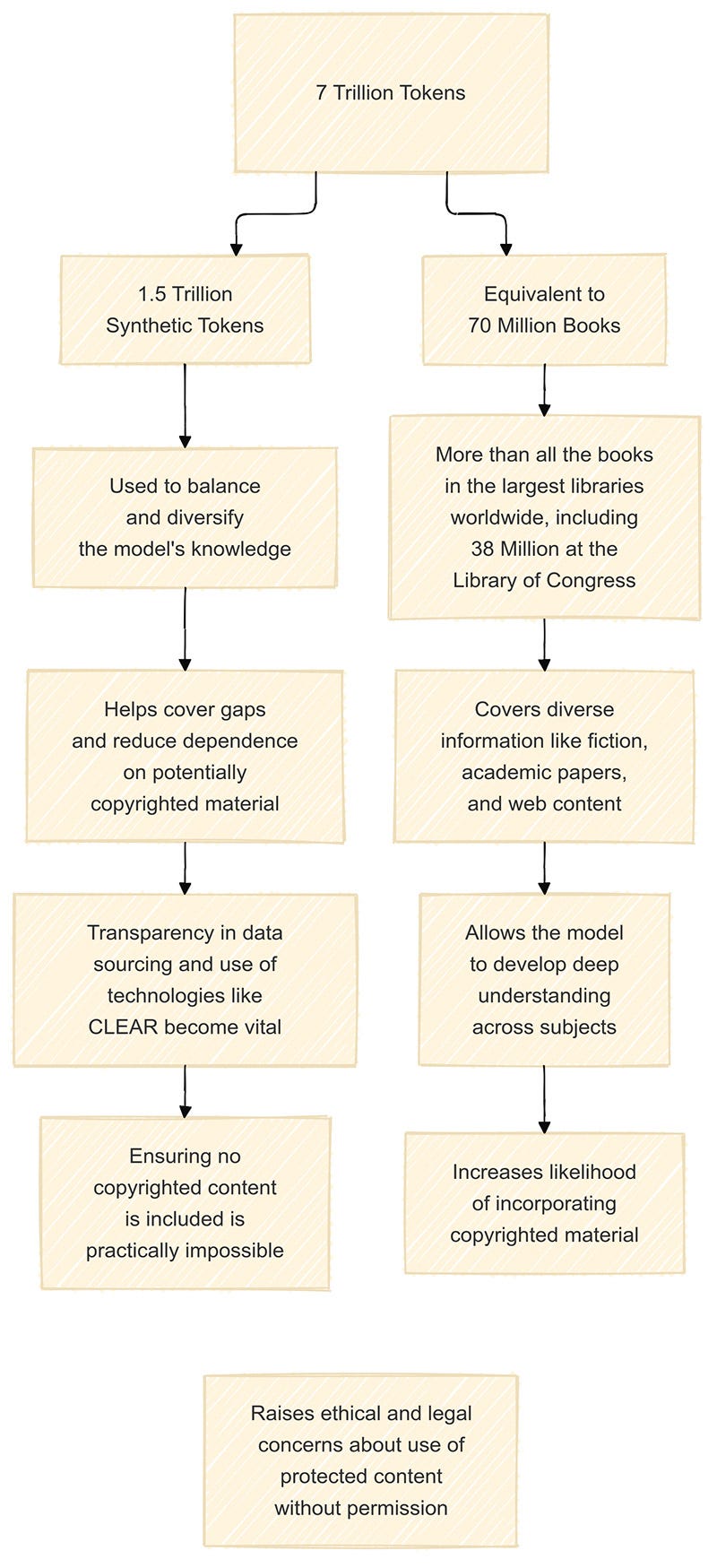
However, this enormous scale also highlights a significant limitation: ensuring that the data used to train such models complies with regional regulations. Models like Hunyuan-Large are not available in highly regulated areas such as the European Union, the United Kingdom, and California, which limits their applicability in regions that enforce stringent data protection and AI transparency laws. The absence of these models in regulated markets complicates the ability to address unauthorized uses of music metadata comprehensively. The lack of availability in these key jurisdictions makes it challenging to fully leverage AI’s potential for unlearning and correcting unlawful metadata entries, leaving gaps in compliance and enforcement.
The CLEAR Benchmark for Ethical Metadata Management
The CLEAR benchmark for Ethical Data Management provides a systematic approach to removing unauthorized metadata. By leveraging Character Unlearning techniques in textual and visual modalities, CLEAR helps platforms ensure privacy, accuracy, and compliance, even without the most advanced AI models at their disposal. AI-driven unlearning techniques are particularly effective at identifying and removing misleading metadata, helping to maintain accurate records. This approach mitigates both legal and operational risks, supporting a more transparent and reliable music ecosystem.
Nevertheless, without the computational power of advanced models like Hunyuan-Large in regulated regions, the process of unlearning unauthorized metadata becomes a more resource-intensive and piecemeal effort. While tools like CLEAR provide a structured approach, they cannot fully compensate for the efficiency and depth of understanding offered by cutting-edge models trained on such massive datasets.
Compliance Challenges with AI and Data Regulations
Ensuring compliance with evolving AI regulations is a significant challenge for music platforms, particularly given the absence of the most powerful AI models in key jurisdictions. Laws like California’s SB 942 (the AI Transparency Act) require that AI-generated content include detectable provenance information to ensure transparency. Automated unlearning techniques can help ensure compliance by removing unauthorized metadata, but the lack of access to models like Hunyuan-Large means that platforms may struggle to achieve the same level of precision and scale in their compliance efforts.
In Europe, similar regulations emphasize transparency and standardization in managing digital rights. AI-driven metadata management techniques are essential for aligning with these regulations, but the unavailability of the latest AI tools in these regions makes it harder to address unauthorized metadata comprehensively. As a result, the risk of non-compliance and the associated legal ramifications remain significant concerns for digital music platforms operating in these areas.
Implications for Songwriters and Artists
The lack of access to advanced AI tools in regulated regions also has implications for fairness in royalty reporting. Inaccurate metadata often results in underreported or unreported royalties, particularly for cover songs and remixes. AI-driven metadata management can enhance the accuracy of records, ensuring that every version of a song is properly documented and that all contributors receive their rightful royalties. However, without the computational advantages offered by models like Hunyuan-Large, platforms may find it challenging to fully address these issues, resulting in continued financial disparities for artists and songwriters.
Unlearning strategies, such as those facilitated by the CLEAR benchmark, help promote fairness, but they cannot entirely overcome the limitations imposed by restricted access to the most powerful AI technologies. This gap underscores the need for continued innovation in ethical AI deployment that complies with regulatory standards while maximizing the benefits for all stakeholders in the music industry.
Building Trust in the Digital Music Ecosystem
Integrating AI-based unlearning methods alongside compliance with new AI transparency laws allows for a more robust approach to managing metadata. However, the absence of state-of-the-art models like Tencent’s Hunyuan-Large in regulated markets weakens the ability to handle the complexities of unauthorized information comprehensively. Building trust with artists, rights holders, and audiences requires not only adherence to legal standards but also the use of the most effective tools available — something that is currently not feasible in many regions due to regulatory restrictions.
Blockchain technology offers some potential solutions by providing transparency through an immutable record of copyright-related transactions. By leveraging blockchain-based CopyrightChains and smart contracts, platforms can enforce licensing conditions and ensure prompt royalty payments. This approach, combined with AI-driven metadata management where possible, supports a sustainable and trustworthy digital music ecosystem, despite the current limitations in AI tool availability.
Ultimately, AI holds immense promise for managing unlawfully obtained music metadata. To navigate this complex environment, platforms must balance the use of ethical data management techniques like CLEAR with compliance efforts and emerging technologies such as blockchain to foster trust and fairness in the digital music industry.