The copyright guard. Who patrols the road when no one is watching?
Building the road was the hard part. But a road without enforcement is just a very expensive suggestion. Having a partner investing in Copyrights means having a Copyright Guard safeguarding their investment...

Loading...
Verify on BlockchainThe first part of this story described the infrastructure.
Every track is a car.
Every car has a license plate and a CopyrightID, which is permanently recorded on the blockchain when a work is registered. The tollbooth knows who enters the road, what they are carrying, and who owns it. The travel token keeps the entire system moving.
That infrastructure is real, and it addresses a problem the music industry has never adequately solved: establishing verified ownership before a work enters commercial circulation, rather than rushing to prove it afterward.
But there's a second problem, and it's been hiding in plain sight.
A road with license plates, toll booths, and a permanent traffic history is still a road. Cars still drive on it. And not every car on the road has a valid plate.
The problem with open roads
The music distribution network is huge. There are over 20 major streaming services, more than 30 social media platforms, and many regional services across Africa, Asia, the Middle East, and Latin America, all constantly adding new audio content, monetizing plays as soon as they happen, and almost none of them verifying if the cars on their roads belong to the right owners.
A car with a stolen plate looks just like a real vehicle until someone stops it and checks the number. The difference on a music platform is that the stolen car might have been streaming for weeks, earning royalties that belong to someone else, before anyone notices. Or it may never get noticed at all.
Unauthorized uploads, fake track identifiers, AI-generated content that sounds like registered artists, and viral videos using unlicensed music as background, these all represent the same underlying issue. They are like vehicles on the road with no right to be there, with forged plates, or legitimate-looking cars that quietly siphon toll revenue into the wrong account.
On today's roads, this occurs constantly. Between 10 and 30 percent of streams on smaller platforms involve unauthorized content. A single streaming service reported 60,000 uploads of AI-generated tracks in one day. Spotify removed 75 million spam tracks in a year.
These are not rare cases.
There are structural issues on a road with no patrol.
Enter the Copyright Guard
Every road that handles traffic responsibly has highway police. Officers patrol the lanes, check plates against the registry, pull over vehicles that don't belong, and clear the road of anything that poses a danger or disruption to legitimate travelers.
On the CopyrightChains road, that role is held by Copyright Guard.
Copyright Guard is the automated monitoring layer, the patrol unit that watches every major road in the music distribution network, every day, nonstop. It doesn’t wait for a complaint. It doesn’t depend on artists reporting suspicious activity. It travels every route, in every territory, constantly, and cross-references every vehicle it encounters against the registration database it already has.

When it detects a car without a valid plate, such as a track listed under a different name, a recording distributed in an unauthorized territory, or a song embedded in a viral video without a sync license, it does not issue a warning. Instead, it acts immediately. A formal enforcement notice is sent to the platform within the hour, accompanied by the CopyrightID, which cryptographically proves ownership. The platform doesn’t need to rely on anyone's word.
The proof is already on the blockchain and can be verified independently in seconds.
How the patrol actually works
Copyright Guard monitors over 60 roads at once, including major streaming services, regional platforms, and social media networks where unlicensed music use is most prevalent and least supervised.
On the well-maintained highways, Spotify, Apple Music, YouTube, Deezer, and Tidal patrol daily. These roads handle the most traffic and generate the highest commercial value. Detection speed here is 24 to 48 hours after an unauthorized vehicle appears.
On regional roads, patrols serving India, the Middle East, Africa, Russia, South Korea, Japan, and China occur weekly. These roads have historically been the least enforced. Independent artists with international audiences have had little presence on them. Copyright Guard changes that. A track that appears on Boomplay in Lagos or Yandex Music in Moscow without authorization is now as visible to enforcement as one that appears on Spotify in Stockholm.
On social media platforms such as TikTok, Instagram, Facebook, YouTube Shorts, Snapchat, Kwai, Likee, Vimeo, Dailymotion, Twitch, and more, the patrol employs a different technique. These channels do not carry audio files with license plates attached. Instead, they host videos where music plays in the background, often with no metadata at all. Copyright Guard listens. It can extract the audio from video content, compare an acoustic fingerprint against every registered work in the CopyrightChains database, and identify the track by sound even when no metadata is available. A viral video with four million views and an unlicensed soundtrack is not invisible to Copyright Guard.
It is just another vehicle on the road.
The forged plate problem
The most technically advanced threat on the road isn't a car without a plate; it's a car with a forged one.
AI-generated music is increasingly created to resemble registered artists, distributed under fake identities, and placed on streaming platforms, where it directly competes with the originals for listener attention and access to the same royalty pool.
The license looks authentic.
The vehicle looks like a car.
But the license number is not listed in the registry.
Copyright Guard detects forged plates by adding a second layer of inspection. In addition to verifying whether a track's CopyrightID matches a registered work, it also analyzes the audio using spectral analysis, harmonic pattern matching, and structural similarity scoring. An AI-generated track that closely mimics a registered recording and can compete with it triggers an investigation, even if the metadata reveals nothing. The acoustic inspection catches what the license plate check misses.
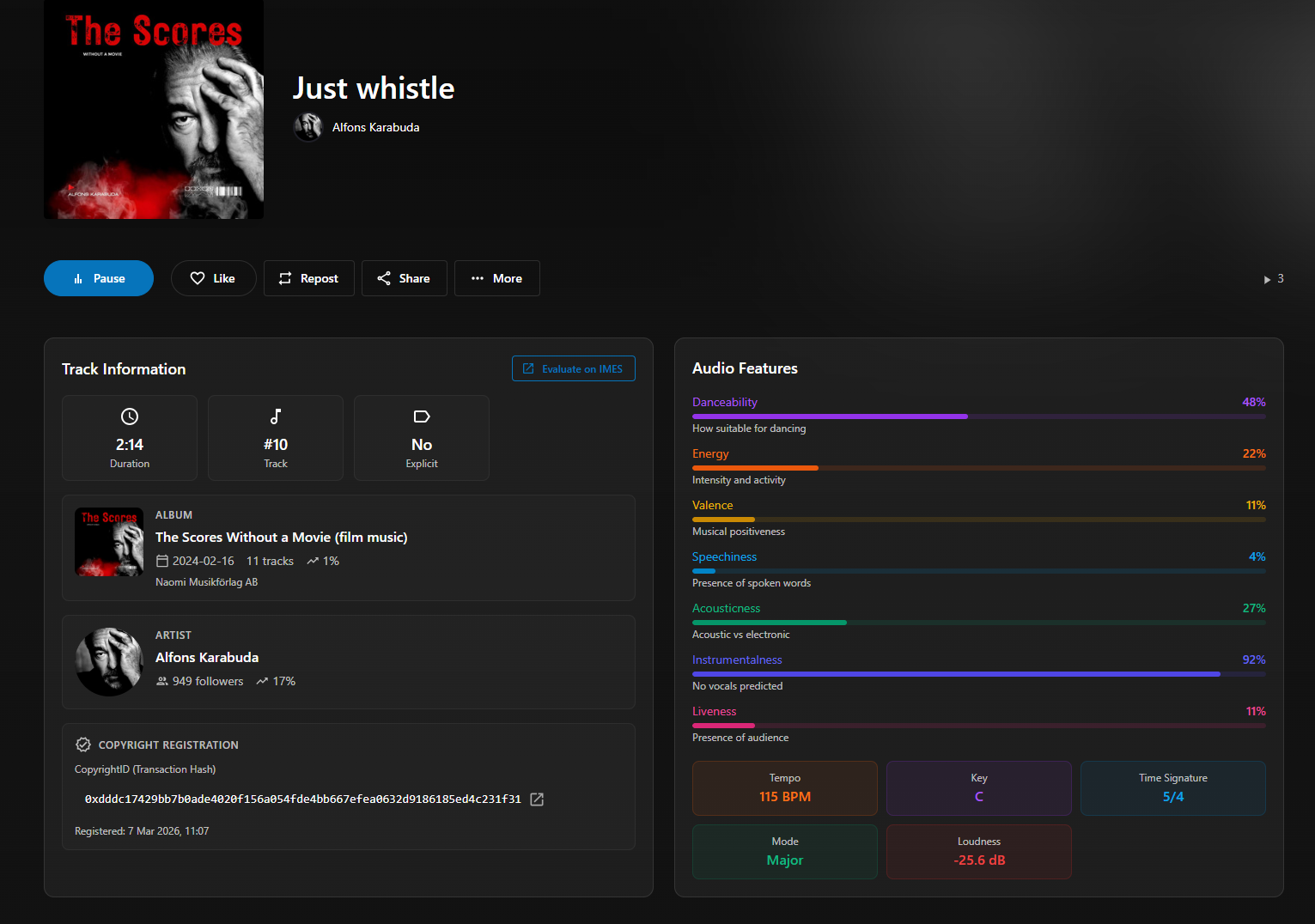
It also monitors for something even more specific: DDEX AI disclosure tags, the metadata markers that compliant AI platforms now include with their outputs to indicate that they are machine-generated. Copyright Guard scans for these tags on every platform that supports them, flagging AI-generated content that appears alongside registered human works and competes with them for recommendations and royalties.
The car is identified not only by its license plate but also by its engine.
Why the tollbooth alone was never enough
The tollbooth, NIMPay, and the registration gate determine who has the right to be on the road. The license plate and the CopyrightID verify this with permanent, verifiable proof. The travel token, NUT, keeps the entire infrastructure economically functional.
But a system that only registers vehicles and never checks whether they are being respected on the road they paid to enter is a system that protects rights on paper. The music industry has operated this way for decades. Rights exist in registries. Music circulates regardless. The connection between the two has always been loose, slow, and dependent on whoever had the resources to enforce it manually.
Copyright Guard tightens that connection. It runs the plate of every vehicle it encounters against the CopyrightID database in real time. The enforcement notice that results from a match carries the weight of a verified blockchain record, not a self-asserted claim. Platforms comply at a rate of 85 to 95 percent, far above the 60 to 75 percent industry average for standard takedown requests, because verification is independent and proof is immediate.
What changes for the artist on the road
Before Copyright Guard, an independent artist's rights could be defended in court but were not obvious in practice. The license plate was recorded somewhere. No one was out on the roads checking.
After Copyright Guard, the license plate is actively checked against every vehicle on all roads where the registered work travels. Unauthorized use doesn’t go unnoticed because nobody was looking. Copyright Guard was watching.
For an artist with a small catalog and modest streaming numbers, this is especially important in synchronization. A track that earns modest streaming royalties can generate thousands of dollars from a single brand using it in an advertisement video. That revenue only flows if someone detects the use and pursues the license. Copyright Guard identifies it. The subsequent conversation, pay for what you used, or remove it , is one that simply never occurred before because nobody knew the unlicensed vehicle was on the road.
For an investor holding royalty shares in a registered work, Copyright Guard serves as the audit function, verifying that the asset is actively managed. A catalog that produces documented enforcement actions, a growing record of successful takedowns, and ongoing licensing discussions indicates a well-managed asset. Conversely, a catalog with proper registration but no active monitoring is like a car parked at the curb, with plates on and engine off, while traffic passes by.
The road is only as good as its enforcement
The first piece in this series argued that the music industry's infrastructure failure is structural rather than accidental. Too many participants benefit from the delay between a song's release and the settlement of rights. Registration-first infrastructure addresses this delay on the front end. Copyright Guard addresses it at every subsequent point.
A road without police isn't really a road. It's just a suggestion. And the music industry has relied on suggestions for way too long.
Every car on this road now has a license plate. Each plate is registered before the car starts moving. Additionally, every road has a patrol unit operating 24/7 across 60 jurisdictions, checking plates, pulling over fake ones, and ensuring the revenue goes to the right driver it was always meant for.
The road is open, and the guard is on duty. Travel with confidence.