The music Spotify stopped paying for…
AI assistants already fetch ProofProfile's 2,006,167 artist records with no sales pitch, because each is machine-readable and Bitcoin-dated. The same design now extends to 150 million recordings Spotify stopped paying for because they had fewer than 1,000 annual streams.
Loading...
Verify on BlockchainAI services are already indexing and collecting the ProofProfile registry of 2,006,167 artists, drawn from music databases as they were before 2022.
They found it without a sales team, and they keep collecting from it because every record is machine-readable and includes a verifiable date.
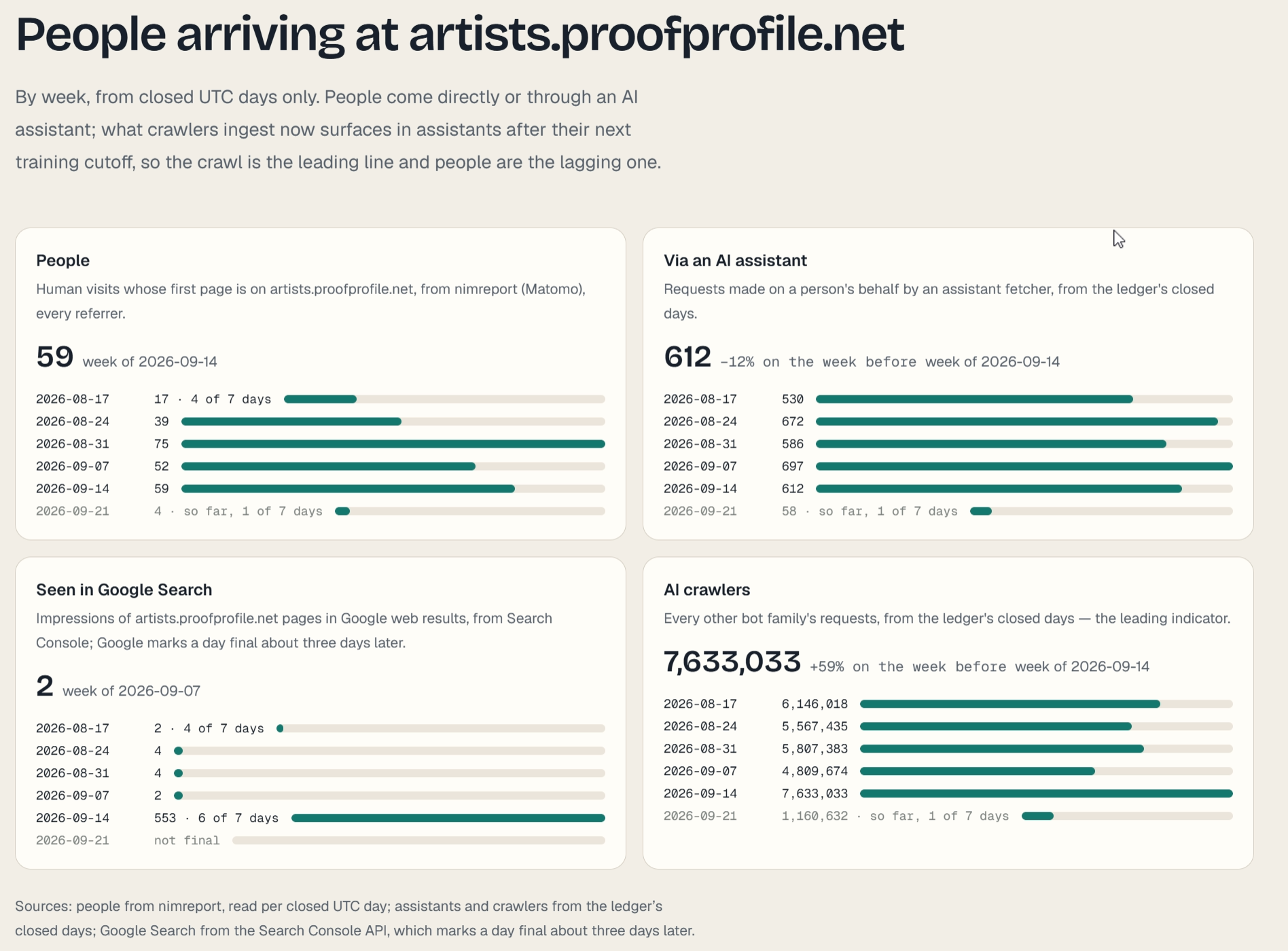
Latest update
Weekly totals, counting only days that have fully ended.
People reach the register either directly or through an AI assistant. What AI crawlers collect today appears in AI assistants' answers after those models are next retrained, so AI crawler activity predicts human visits, and human visits confirm the prediction weeks or months later.
ProofProfile is now applying the same design to a catalog seventy-five times larger, 150 million recordings that currently earn nothing.
Since 2024, Spotify has paid no royalties on any track with fewer than 1,000 streams in twelve months. That rule cut off payments to most of the world's recorded music by count, the long tail of songs that were released, credited, and then heard by almost no one.
ProofProfile holds 210,822,810 such recordings with a popularity score of zero. After quality filtering, more than 150 million distinct recordings remain, credited to 13,899,593 artists.
Their streaming income today is nil.
AI developers value these recordings differently.
They need very large volumes of human-made music that can be shown to have been properly identified and obtained. That supply stopped growing when generative tools began releasing music at commercial scale.
Most of this catalog comes from source data older than that.
The exact share awaits reconciliation with MusicBrainz, AcousticBrainz, and public sources, which is currently in progress.
A large part is already confirmed.
In the last full generation, 64,980,542 zero-popularity recordings included at least one credited artist with a notarized record on artists.proofprofile.net. Each of those records was anchored to the Bitcoin blockchain in mid-2026, proving it existed in its present form by that date.
A competitor starting today can only ever produce a later date for the same material, no matter how much it spends. The anchor says nothing about who made the music, and ProofProfile claims nothing beyond the date.
Any buyer can verify it without taking ProofProfile at its word.
Marketing this is cheap.
Giving each artist a unique identity is a data-engineering task on the infrastructure ProofProfile already runs, and the full catalog fits on an easily expandable infrastructure.
Artists' and their songs' marketing is automated as well.
Each recording and each artist gets one document written for AI agents, which find, index, and ingest it on their own, exactly as they already collect the notarized registry.
Growth comes from demand by AI services for fully autonomous ingestions.
The catalog offers two assets.
- The first comprises 64,980,542 recordings by artists who already hold notarized, pre-2022 records, material that is ready to offer and whose evidence no competitor can copy.
- The second comprises 10,952,699 or more artists who have no verified identity anywhere today. Each now receives a single record of their own, so that artists who share a name can no longer be confused and any buyer knows exactly whom to credit and pay.
The second group is five times larger than the first by artist count, and today the streaming market pays it nothing.