Why the quantum computing threat is not your problem if you hold NIM tokens
The quantum computing challenge is real. For NIM participants, it is also mostly someone else’s problem.
Loading...
Verify on BlockchainSomething significant shifted in the last week of March 2026. Two separate technical documents arrived within days of each other, one from Google’s quantum computing team and one accidentally leaked by Anthropic, the company behind Claude AI. Neither received mainstream headlines in proportion to what they actually signify. But together, they redefined the risk landscape for digital assets in a way that every creator and investor must understand. They present a quietly compelling case for why the NIM ecosystem was built the right way from the start.
The threat, without the technical fog
Every Bitcoin and Ethereum wallet is protected by a pair of keys, one private, kept secret by the owner, and one public, visible on the blockchain when you make a transaction. The security of your assets entirely relies on the fact that it’s mathematically impossible to reverse-engineer the private key from the public key.
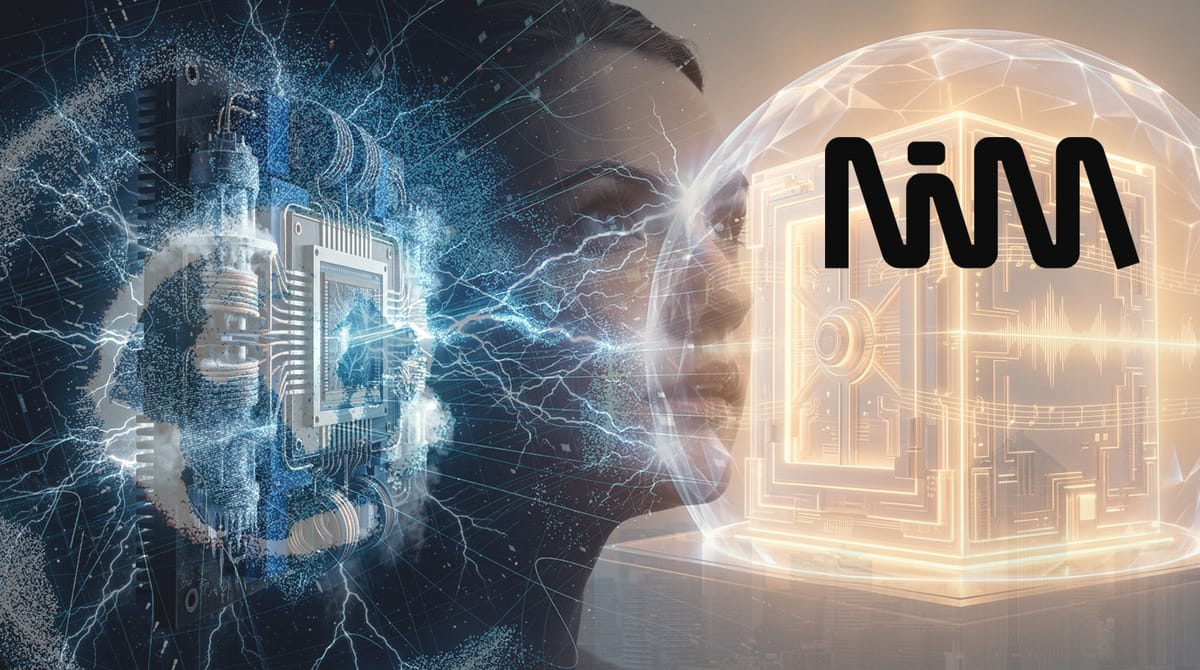
Quantum computers threaten to make that reversal possible. Google’s recent research indicates that the hardware needed for this attack is now 20 times more feasible than previously thought. A separate team at Caltech lowered the threshold even further and observed that their existing machine is already close to it.
This doesn’t mean wallets are being compromised today. What it indicates is that the comfortable buffer of “this is decades away” no longer exists. Google is migrating its own security infrastructure to quantum-resistant systems by 2029. The US government has set the same deadline for its agencies. The difference between theoretical risk and practical threat is now measured in years, not generations.
The most vulnerable assets are those most people consider safe: wallets that have previously transacted, whose public keys are already permanently visible on the blockchain. About 6.9 million Bitcoins are currently in this situation. On Ethereum, over $200 billion in stablecoins and tokenized assets depend on administrative keys that rely on the same vulnerable cryptographic scheme.
Where AI enters the picture
Three days before the Google paper, Anthropic accidentally revealed thousands of internal documents due to a misconfigured system. Among these were details about an unreleased AI model, internally called Claude Mythos, that Anthropic’s own assessments describe as significantly more advanced than any existing AI system in cybersecurity capabilities.
The key ability here isn’t just “better security software.” It’s the capacity to identify entirely new types of vulnerabilities through original reasoning and analysis that previously required expert human skill and significant time. Anthropic describes the model as heralding a wave of AI systems that can find vulnerabilities faster than defenders can respond to them.
A documented real-world case clearly shows what this looks like in practice: a state-sponsored group used an earlier, less advanced AI model to carry out coordinated intrusions across about 30 organizations, with the AI managing most of the operational workload on its own. Mythos represents a major leap in capability beyond what made that campaign possible.
The link between quantum computing and AI-assisted attacks is functional. Breaking blockchain cryptography at scale isn’t just a math problem; it involves targeting, timing operations, and handling multiple wallets simultaneously. Advanced AI systems are designed for this kind of ongoing, automated, and focused effort. Together, these capabilities increase the risk much faster than either could alone.
Why NIM tokens sit outside this threat
Here is where the picture shifts from concern to clarity.
The quantum threat specifically targets raw self-custodied cryptocurrency wallets in which the owner personally manages cryptographic keys and the public key has been published on a public blockchain. This is the built-in weakness being exploited. It is not an inherent flaw in all digital assets, but a flaw in a specific architecture.
The NIM ecosystem was not built on that architecture.
NUT, the NIM Utility Token, serves as an internal network currency. It facilitates copyright registration, AI monitoring, licensing decisions, platform access, and a base for royalty payments within the CopyrightChains network. It is not a speculative asset traded on public exchanges against an exposed ECDSA key pair. Instead, it functions as a practical tool within a closed, purpose-built infrastructure centered on music rights, where the platform handles the cryptographic management layer seamlessly, behind an interface that displays only the user’s NUT balance.
When a creator or investor interacts with the NIM ecosystem, they are not managing private keys. They are not exposing public keys on a general-purpose blockchain. They are working within a system that handles the technical layer for them, encrypted with a standard designed to remain secure for at least seventy years.
Royalty settlements and distributions are conducted in USDC, a regulated stablecoin supported by professional custodial infrastructure that actively maintains and upgrades its security. When post-quantum cryptographic standards become the standard across financial systems, that security layer updates itself. Individual NIM participants do not need to manage that transition.
The deeper protection that most digital assets cannot offer
What makes the NIM ecosystem truly resilient in this environment is not only its token architecture but also the dual legal protection embedded within its structure.
Each work registered in the NIM ecosystem is housed within a dedicated incorporated company, a single-purpose legal entity that owns the license, earns royalties as business income, and distributes them as dividends through specified share classes. An investor in NIM holds rights protected by two completely independent legal systems operating simultaneously.
Copyright law safeguards the underlying work. The company structure protects the income stream. If anyone attempts to intercept, misdirect, or misappropriate the royalties generated by the work, they are not just violating a contract. They are attacking a legally incorporated company, invoking corporate law remedies, directors’ duties provisions, and the full spectrum of commercial enforcement, in addition to copyright infringement claims.
This differs fundamentally from what a raw cryptocurrency wallet provides. A wallet is essentially a cryptographic key, and its security relies entirely on the mathematics protecting that key. When that mathematics faces pressure, as the Google paper now confirms, the security weakens. Corporate law and copyright law do not weaken when quantum computers become faster.
What this means if you are a creator
Your music earns royalties whenever it is played on streaming platforms, radio, in sync placements, or at live performances. The NIM ecosystem transforms that income into a precise, auditable, AI-monitored cash flow that settles in stable currency without requiring you to understand cryptography, manage keys, or monitor blockchain activity.
The quantum threat is, practically, a concern for individuals holding Bitcoin or Ethereum in self-custody wallets with exposed public keys. It is not a fundamental issue for a creator whose royalty income flows through a purpose-built, legally protected, stablecoin-based infrastructure.
The positive outlook here is well justified: NIM was built on the idea that creators should work with an income system rather than a cryptographic one. That design, chosen for usability and legal clarity, aligns with the direction the security landscape is heading.
What this means if you are an investor
Music royalties have three characteristics that make them especially appealing as an asset class: durability, predictability, and low correlation with financial markets. A commercially valuable song earns licensing income from streaming, broadcasting, synchronization, and live performance across various platforms and in multiple regions, regardless of whether stock markets are rising or falling.
The NIM architecture transforms that income into a structured financial instrument: Class B shares in a single-purpose company that receives a priority share of distributable royalty profit, settled in USDC on a specified schedule. The chain of title is cryptographically recorded, the income is auditable, and the legal rights are enforceable through both copyright and corporate remedies.
In an environment where the quantum pressure on raw crypto assets is increasing, the comparative advantage of yield-generating instruments backed by real-economy activity, rather than by the mathematical difficulty of reversing an elliptic curve, becomes more evident, not less.
The practical takeaway
The window to avoid urgent action on quantum security is closing. That is the honest message from the Google paper, and it deserves to be taken seriously by anyone with significant exposure to raw self-custodied cryptocurrency.
For creators and investors working within the NIM ecosystem, the more relevant point is that the design choices already made, NUT as an internal utility currency, settlements in USDC and USDT, cryptographic management handled by the platform, income rights protected by corporate and copyright law, describe exactly the kind of architecture that holds up well as the threat environment evolves.
The quantum computing challenge is real. For NIM participants, it is also mostly someone else’s problem.