Your copyright should follow your music everywhere it goes. Now it can…
The combination of unalterable copyright registration and machine-native payment infrastructure means your copyright can now follow your content wherever it goes, automatically pay you every time it is used, and settle in your account within seconds rather than months.
Loading...
Verify on BlockchainYou wrote the song. You registered it. You uploaded it.
Then, you waited.
Six months later, a royalty statement arrived with figures you couldn't verify, deductions you didn't agree with, and no explanation for the usage events you know occurred. This is not an isolated case. It is the normal experience for every creator who has ever tried to make a living from their work in the digital economy.
That is about to change, not gradually, not partially, but fundamentally.
The fundamental challenge.
Copyright and content became separated
When you release a piece of music, the content spreads. It gets streamed, sampled, remixed, licensed, embedded in videos, used in AI training datasets, queried by recommendation engines, and consumed by automated systems across hundreds of platforms simultaneously. Your copyright, meanwhile, remains in a registration database somewhere, completely disconnected from all of that activity.
Traditional collection societies try to close this gap through a series of manual steps: usage monitoring, matching, attribution, calculation, reporting, and eventually payment, a cycle that takes 45 to 180 days from when your content is used to when you get paid. Even then, these societies only achieve about 53 percent efficiency in collecting royalties. The music industry loses around $163 billion in value each year because this matching process fails at scale. About $2.5 billion remains permanently undistributed in "black box" royalty pools because the ownership chain cannot be reliably established to release the funds.
The root issue is structural.
Copyright registration was created as a static record, a timestamp, and a name in a ledger. It was never meant to travel with the content, respond to how it's used, or trigger payments automatically. The content entered the digital age. Meanwhile, the copyright remained in the filing cabinet.
It starts with immutable registration
The first and essential step in fixing this is ensuring your copyright is maintained as a permanent, machine-readable record before any automated payment system can send money back to you.
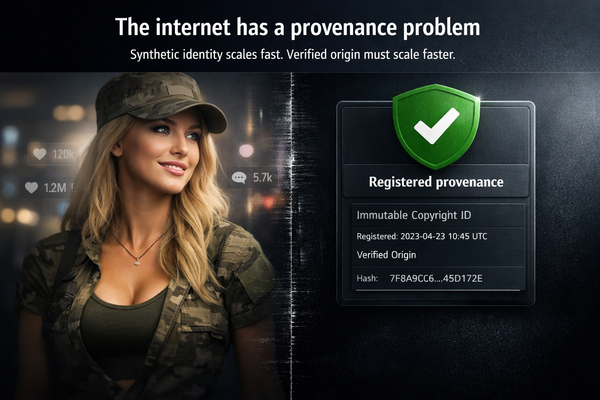
CopyrightChains provides that foundation. When you register a work on CopyrightChains, the platform's AI-powered verification layer, which uses multi-model consensus, verifies the authenticity and originality of your work, generates a cryptographic digital fingerprint, and records an immutable CopyrightID on the blockchain. This isn’t a centralized database entry that an administrator can change or delete. Instead, it’s a cryptographic record with a block timestamp accurate to the microsecond, which can be used as evidence in copyright disputes and is permanently linked to your verified identity through the NIM framework.
That CopyrightID serves as the foundation for everything else. It is the address where your copyright resides in the machine economy. Every licensing event, every payment, every usage detection traces back to that identifier. Without it, the machine cannot locate you. With it, the machine always knows where to send the money.
Stripe just built the payment layer that makes royalties instant
In February 2026, Stripe enabled support for x402, a machine-native payment protocol that uses the HTTP 402 status code to embed payments directly into the request cycle of any internet interaction.
The importance of copyright owners is specific and tangible.
Any content resource accessible through an x402-enabled server endpoint can now automatically charge a fee, as low as $0.01, each time an AI agent or automated system requests access. The agent sends a request, and the server responds with payment terms. The agent pays in USDC, and the server delivers the content. The entire transaction settles on the Base network in about 200 milliseconds, with a full on-chain record of the event.
Stripe acts as the backend for this process, converting incoming payments into your existing Stripe balance, denominated in your local fiat currency, on your regular payout schedule. Tax calculation, fraud protection, and reconciliation are all handled through Stripe's existing tools, the same infrastructure trusted by millions of businesses worldwide.
You don't need a crypto wallet or understand blockchain settlement.
You simply register your copyright on CopyrightChains, set up your licensing endpoint with your payment details, and Stripe manages every step from "AI agent consumed your content" to "funds appear in your account."
This is not just a workaround or an experimental integration. Stripe is one of the most trusted payment infrastructure providers worldwide, handling hundreds of billions of dollars each year. Its involvement is a sign of quality assurance that machine-native copyright payments have moved from a technical idea to a reliable, institutional-grade infrastructure.
Your copyright now follows your content
Here's what this looks like in practice for a musician, producer, or publisher registered on CopyrightChains.
An AI music production tool needs access to a licensed drum sample from your registered catalog. It sends an HTTP request to your CopyrightChains licensing endpoint. The server responds with a 402 (Payment Required) status and provides Stripe's payment details. The AI tool pays $0.01 in USDC.
The transaction is confirmed.
Your licensing endpoint grants the sample access authorization. The entire process takes less than two seconds. Your CopyrightChains account records the usage event against your CopyrightID. Stripe queues your $0.01, minus a small processing fee, for your next payout.
Now multiply that by ten thousand AI agents consuming creative works simultaneously across different platforms and geographies, at any hour of the day. Each one pays per use.
Each payment settles in seconds.
Each transaction is recorded immutably against your CopyrightID.
This is not a future scenario; it is the architecture that is operational today, waiting for copyright owners to register their works and configure their endpoints.
The copyright is no longer just a static record in a database. It has become an active, machine-readable economic asset that earns money every time it is used, anywhere it moves, without needing your involvement in any individual transaction.
What this means for investors
For investors assessing copyright as a financial asset class, the implications are equally important.
Institutional investment in any asset class depends on the quality and verifiability of cash flows. Traditional royalty investment requires trusting manually compiled statements from collection societies, accepted on faith because the underlying data is opaque and the reconciliation methodology is inaccessible. This is why royalty funds have historically required five-year lockup periods and accepted 4 to 8 percent annual returns, the premium for illiquidity and opacity.
x402-enabled copyright assets, registered on CopyrightChains and structured through Wyoming Series LLC vehicles, generate on-chain cash flows that are timestamped, denominated in USDC, and auditable by any credentialed party in real time.
For instance, Authenta Invest's zero-knowledge compliance reporting (powered by CopyrightChains) allows investors to verify portfolio performance across any time window, by usage type, geography, content category, or individual CopyrightID, without the platform exposing sensitive counterparty or licensing data.
The result is a copyright investment vehicle that offers 14 to 25 percent annual returns with monthly liquidity options, compared to 4 to 8 percent from traditional royalty funds with five-year lockups. That performance gap is directly caused by two structural advantages:
- an AI-optimized licensing infrastructure that delivers 40 percent higher yields than manual licensing processes,
- and machine-native payment rails that eliminate the 15 to 30 percent overhead costs seen in traditional royalty distribution systems before creators and investors receive any returns.
The verification layer that protects everyone
Machine-native payments at scale rely on trust, and trust depends on verified identity. An AI agent paying for a commercial license must provide both payment and credentials confirming the appropriate verification level. This ensures that licensing fees are paid to the correct rights holders, that permissions for derivative works are enforced automatically, and that territorial restrictions are applied at the transaction level rather than relying solely on platform policy enforcement.
For creators, this means every payment entering your CopyrightChains account is traceable to a verified identity. For investors, it means that the licensing activity behind your returns is KYC-verified and can be audited for compliance. For the entire ecosystem, it means that the $2.5 billion in undistributed black-box royalties, which largely exist because ownership can't be established with sufficient certainty, becomes a technical problem rather than a structural inevitability.
Registration is the only step that is yours to take
The machine payment infrastructure is established. Stripe has implemented it. CopyrightChains manages the registry. Wyoming supplies the legal framework. Authenta Invest provides the institutional vehicle.
The key action that determines whether your copyright travels with your content or remains in the filing cabinet is immutable registration on CopyrightChains. That registration serves as the anchor point from which every automated royalty payment, machine-native licensing transaction, and on-chain usage record flows back to you.
An unregistered copyright remains unseen by the machine economy. Once registered, it becomes a real-time, machine-verified asset that generates revenue whenever an AI agent, platform, or automated workflow uses it, anywhere in the world, at any hour, without anyone needing to press a button.
Your music is already traveling. The question is whether your copyright is traveling with it.