Human-made! The one proof money can't buy
Human music is the training data every generative model learned from, which makes it the original, not a parallel option. Organic food tastes better because of how it's grown; human music holds up for the same reason. Human performance is the real ingredient AI can only approximate.
Loading...
Verify on BlockchainThe one thing nobody can fake, no matter their budget or compute, is having been first. That's what ProofProfile actually sells. A timestamp anchored to a clock nobody, including ProofProfile, controls.
Organic food tastes different because it is different. Better soil, no synthetic shortcuts, ingredients grown the way they were grown before anyone needed to add a label explaining it. The label didn't invent the quality, it just made the quality provable to a buyer who couldn't taste the soil for themselves.
Human music deserves the same honesty. It isn't "different" from AI music in some neutral, no-judgment sense. It's the original. Every generative music model on the market today was trained on catalogs of human recordings, the phrasing, the timing, the imperfections, the decades of songwriters figuring out what moves people. If human music were inferior, there would be nothing worth training a model on. The fact that AI systems exist by studying human performance is the strongest possible argument for the superiority of the thing they're studying.
The one thing that can't be bought
What makes this more than a taste preference? AI companies can buy compute, buy talent, buy data licenses, and buy their way to a better-sounding model.
There is exactly one thing they cannot buy.
An earlier moment in time.
Once a recording is anchored to a public, decentralized timestamp, that record's position in time is fixed. Nobody can go back and insert an earlier one, not with more money, not with more engineers, not with a better model next year. Time does not negotiate.
This is the part that makes provenance different from every other AI defense strategy on the market.
- Watermarks can be stripped.
- Metadata can be edited.
A timestamp anchored to Bitcoin cannot be predated by anyone, because predating it would mean rewriting a public ledger that nobody, including the company that built the verification system, controls.
That is what ProofProfile actually provides.
Not an opinion that a recording is human. A record of exactly when that recording's evidence entered a public, tamper-evident chain, checkable by anyone, controlled by nobody. For catalog recordings, that record draws on the human-made music that existed before generative AI systems did.
For new work, a musician who registers a track the day it's finished locks in a claim to being first that no competitor, however large, can ever retroactively beat.
Why brands may pay more
Brands already pay for sustainable packaging, traceable ingredients, and verified carbon numbers, not because these change the product, but because they can prove a claim the customer cares about.
Music works the same way.
A brand that wants to say "this is real" needs something sturdier than an email assurance. A verified, time-anchored record gives it exactly that, turning "we used human musicians" from a talking point into a checkable fact.
Why this matters to musicians
Generative music makes it harder to tell a documented human recording from an anonymous generated one, which makes it harder to reward the people who actually did the work. Registering a recording's identity and timestamp before anyone else can misattribute it is a musician's best defense, and it costs nothing close to a marketing budget.
It doesn't replace copyright or contracts; it gives the evidence behind them a public, permanent anchor.
Why this matters to investors
AI assistants are becoming the place people ask questions and make decisions, and they need dependable records to answer responsibly. A system that can prove, not merely assert, that a piece of human work predates a given moment in time has value everywhere provenance matters: licensing, attribution, rights administration, and discovery. That value only grows as more synthetic content enters the market and the gap between documented and undocumented work becomes the thing worth paying to close.
A label must mean something.
A certified human performance badge is worthless if it's just a box someone checked. It needs to point to a real, inspectable record, exactly the kind of time-anchored proof provides.
That is the difference between a badge and decoration.
The music is still the reason.
None of this replaces the reason people listen: the voice, the melody, the feeling. Proof doesn't create that; it protects the people and history behind it. Organic labeling didn't grow the tomato; it proved how it was grown.
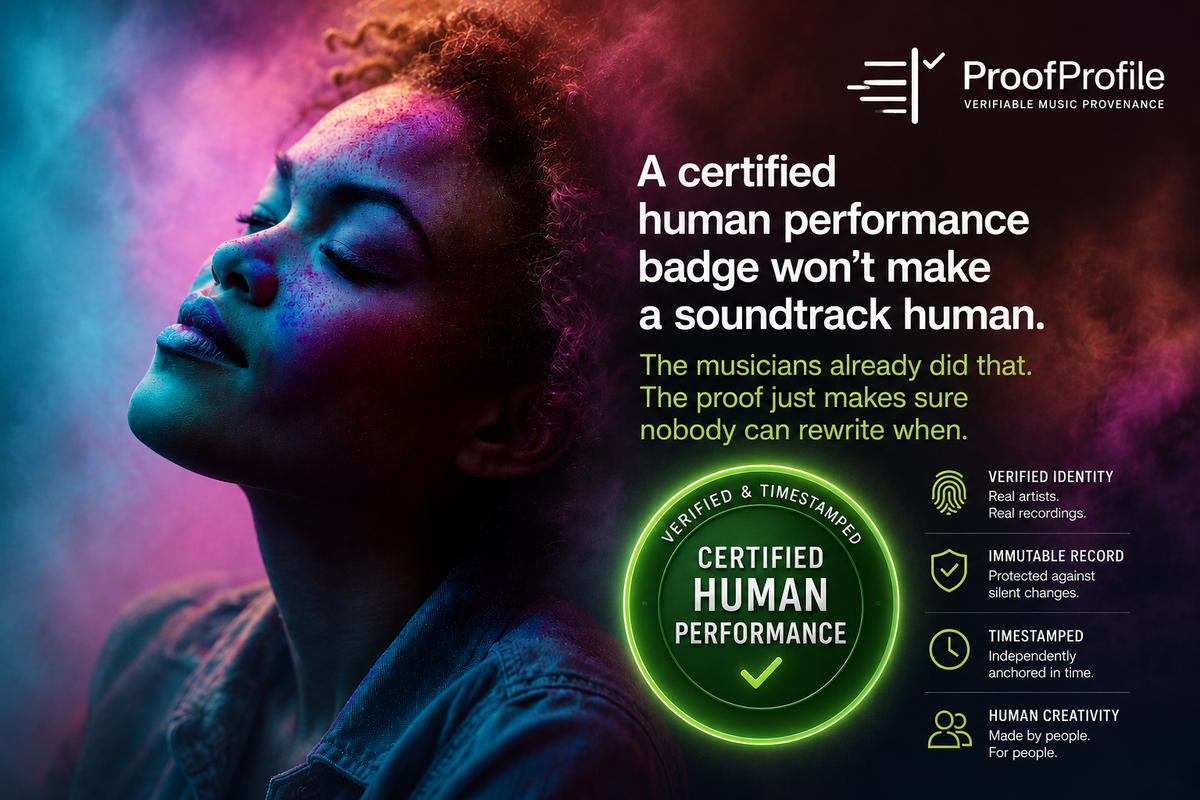
A certified human performance badge won't make a soundtrack human. The musicians already did that.
The proof makes sure nobody can rewrite when.