
When an AI assistant stops guessing and starts checking
Most AI assistants repeat what they once indexed. ProofProfile lets them ask a live question, verify the answer independently against Bitcoin, and stop guessing. That changes what “the AI said so” is worth.
Loading...
Verify on BlockchainAsk an AI assistant about a song, and you get an answer. What you rarely consider is where that answer came from and whether the AI assistant actually checked it or just repeated something it once read. That distinction just became visible because ProofProfile built the first music registry that lets an AI assistant check itself in real time, rather than trusting whatever was indexed months ago.
To see why that matters, it helps to separate three things that sound similar but are not:
- indexing,
- calling a tool,
- Verifying independently.
Most AI answers today rely only on the first.
What just changed is that the second and third are now available too, and together they change what "the AI said so" is worth.
Indexing.
The AI assistant remembers a page, not a fact.
Indexing is the process by which a search crawler visits a webpage, reads it, and stores a copy of what it finds. Later, when you ask an AI assistant a question, it may recall that stored copy or a summary built from it and return it to you as an answer.
This is how the web has worked for thirty years, and it has a quiet weakness. The AI assistant is repeating something it read from a source it did not verify at the moment you asked. If the page was wrong, outdated, or quietly altered after it was indexed, the AI assistant has no way to know.
It is reciting, not confirming.
Calling a tool.
The AI assistant asks a direct question and gets a direct answer.
The Model Context Protocol changes the mechanism. Instead of an AI assistant reading a page and guessing what the words mean, a registry can expose a small set of named actions, called tools, that the AI assistant uses directly and precisely: search for this artist, fetch this exact recording, or check this claim. The AI assistant is no longer parsing a page. It asks a question in a fixed format. It receives a fixed, structured answer, the same way a calculator gives you the same result no matter who presses the button.
This is the technical leap.
ProofProfile is the first music registry to do so. Any AI assistant that speaks the protocol, Claude, ChatGPT, Copilot, and others, can now reach a registry of more than two million notarized artists and their recordings and ask, in real time, at the moment of your question.
Does this exact record exist, and is it what it claims to be?
That is a live lookup, not a memory of a page from last spring.
Verifying independently.
The AI assistant does not have to trust the answer either
Here is the part that goes beyond a normal tool call, and it is the part that actually matters. A tool could return "yes, this is real," and the AI assistant would have no choice but to trust whoever built the tool. ProofProfile's tool does not ask for that trust.
Every record carries two separate proofs.
- One is a registration that produces a permanent reference on a dedicated ledger.
- The other, built entirely independently, is a timestamp anchored to a specific Bitcoin block via OpenTimestamps.
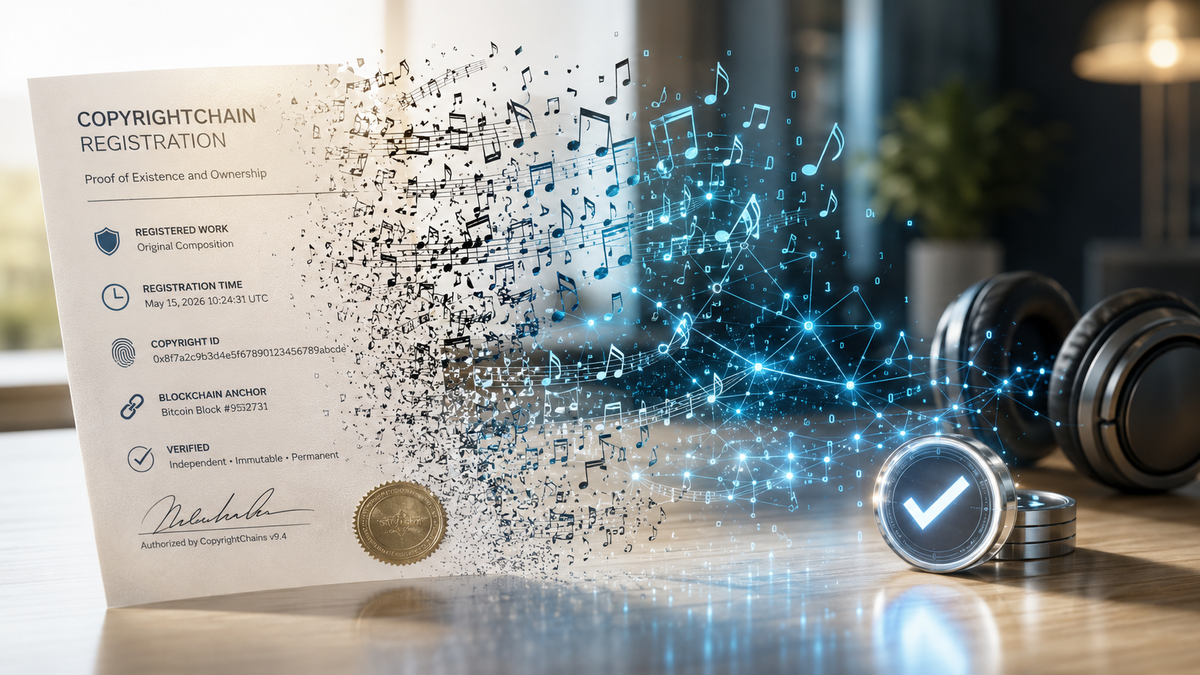
The record itself is converted into a unique code, called a hash, which is locked into the Bitcoin blockchain. Anyone can check it, including the AI assistant itself, and do so on their own, without asking ProofProfile for permission or taking ProofProfile's word for anything.
Here is how the check works.
If even one character in the record changes, the hash no longer matches, and the check fails, in plain view. If nothing has changed, the hash matches, and the check passes. Either way, the proof comes from Bitcoin's public record, not from ProofProfile.
Nobody owns that ledger, and nobody can quietly edit it.
That is the difference between a tool and a verified tool. Calling the tool gives the AI assistant a precise, live answer instead of a stale, remembered one. Independent verification means that you and the AI assistant do not have to trust the messenger to believe the answer.
Why is the combination the point
Put the three together, and you can see what changed. Indexing gives an AI assistant a memory, which can go stale or be wrong. Calling a tool gives it a live, exact question-and-answer, removing the guesswork of reading a page. Independent verification means the answer does not depend on trusting whoever runs the registry, because the proof can be checked against a public record that predates the question and cannot be altered after the fact.
For a music creator, that means a claim that your work existed before a certain date is not a story anyone has to believe. It is a check anyone, human or machine, can run themselves.
For a platform or an investor, it means the difference between a source that sounds credible and one that is mechanically accountable, on demand, at the scale of an entire catalog.
And for the AI assistant answering your question, it means the difference between repeating something it once read and actually checking, right now, whether it is true.