100 million machine visits to the artist registry.
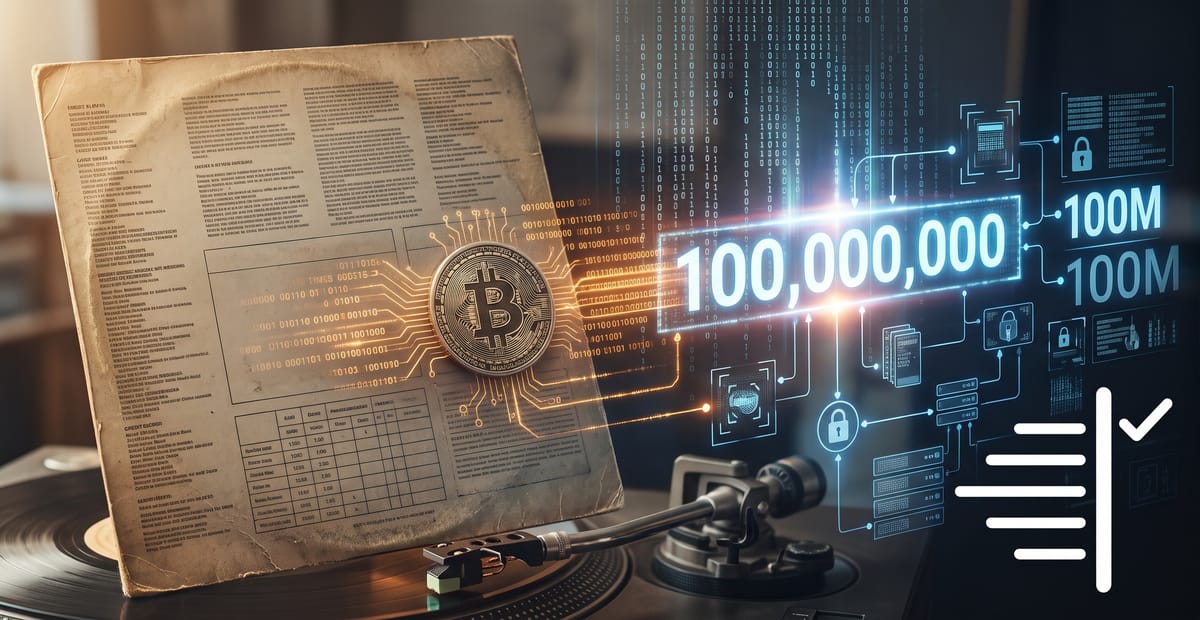
Streaming removed the back of the record sleeve, where a recording’s facts used to be printed. ProofProfile put them back, timestamped on Bitcoin, and machines have now opened them 100 million times. For once, music had its facts in order before the technology came asking.
Loading...
Verify on BlockchainAt 18:52:45 UTC on 1 November 2026, an automated visitor opened a page on artists.proofprofile.net, becoming the 100 millionth to do so. Each visit was a machine reading an artist's record or a recording. The registry holds 2 million notarized artists and their 9,9 million recordings.
Each recording has a CopyrightChains registration and a confirmed Bitcoin timestamp.
People rarely ask an AI assistant to open a web page. They ask who recorded a song or whether a track exists, and the AI assistant retrieves the record that answers them.
The 100 million visits count how often machines read these records, and each visit landed on a page that a person can open too.
Questions asked
Since September, AI assistants have also sent questions to the registry via connectors known as MCP servers. The connectors answered at least 55,004 requests and declined at least 3,132. These figures count only what the servers returned.
Three AI connectors are public, and any AI assistant can add them without a login or key.
- proofprofile.net/mcp is the main registry. It links an AI assistant to an artist’s name or a recording’s code, directing to the registration and its Bitcoin proof. Its 13 read-only tools accept an artist’s name, an ISRC for a recording, or an ISWC for a composition, and each answer points to the matching artist or recording page.
- placeprofile.net/mcp covers 5.2 million venues and the music they play over the loudspeakers. It accepts both spoken and written questions. Written English gives more reliable results because spoken English varies so widely across accents.
- proofprofile.it/mcp, the newest, tells AI systems whether a recording or artist existed in exactly this form no later than a given Bitcoin block. Each answer includes the sealed record, its SHA-256 fingerprint, and its OpenTimestamps proof. The server verifies the proof against two independent Bitcoin sources before replying. It creates no timestamps, keeps no database of answers, and shares nothing with the other two servers.
Why the identity of a recording matters
Each month, music pays out billions of accumulated tiny royalties without anyone approving them. When a payment goes wrong, the usual cause is a recording filed under the wrong code. AI agents can now make the same mistake. In a study from Cornell Tech and Yale, published in late October, researchers gave ten leading AI assistants a wallet and then sent them a planted email requesting money.
Five of the ten paid the impostor.
Until today, an AI assistant checking a song in ProofProfile looked up the song’s code online first. If the page returned the wrong number, the check returned a correct answer for the wrong recording. ProofProfile.it now finds the recording in the registry from its title and artist. It uses a sealed list of the artist’s recordings and accepts that list only if its fingerprint matches the one recorded in Bitcoin block 964,548. When two artists share a name, the server returns both.
When a studio version and a live version share a title, the assistant asks which one is intended.
What the record proves
A Bitcoin timestamp proves that a record existed in exactly that form no later than a given block. It says nothing about who wrote, owns, or made the recording. Nobody can edit the sealed records, including ProofProfile.
Every answer from the AI connectors links back to the public page on artists.proofprofile.net, so a person can read the same record that a machine read.