
Atmosphere is the missing data class. Whoever structures it first wins the AI recommendation layer.
A playlist is operational data. The atmosphere was always there. The structured data was not. How music driving the AI discovery is ending the OTA era, and what venue operators need to do before the window closes.
Loading...
Verify on BlockchainThere is a number that most hospitality operators know but rarely say out loud. It is the percentage of revenue that quietly leaves the business whenever a guest books through an intermediary. For independent hotels, the average OTA commission is 22 percent. For a mid-sized Nordic property, that single number represents the difference between a healthy business and a marginal one.
For two decades, operators accepted this as the cost of visibility. You could not reach the consumer without going through the gatekeepers.
Google ranked you. TripAdvisor reviewed you. Booking.com processed your reservations. Each extracted a toll.
And you paid, because there was no alternative.
There is now an alternative.
And it does not charge commission.
What changed
Between mid-2024 and early 2025, traffic to hospitality venues from generative AI sources grew by 1,700 percent. The search engine, which once accounted for 51 percent of hospitality research behavior, fell to a 36 percent market share by late 2025. Consumers stopped navigating pages of links and aggregated reviews and began asking AI assistants to make decisions for them.
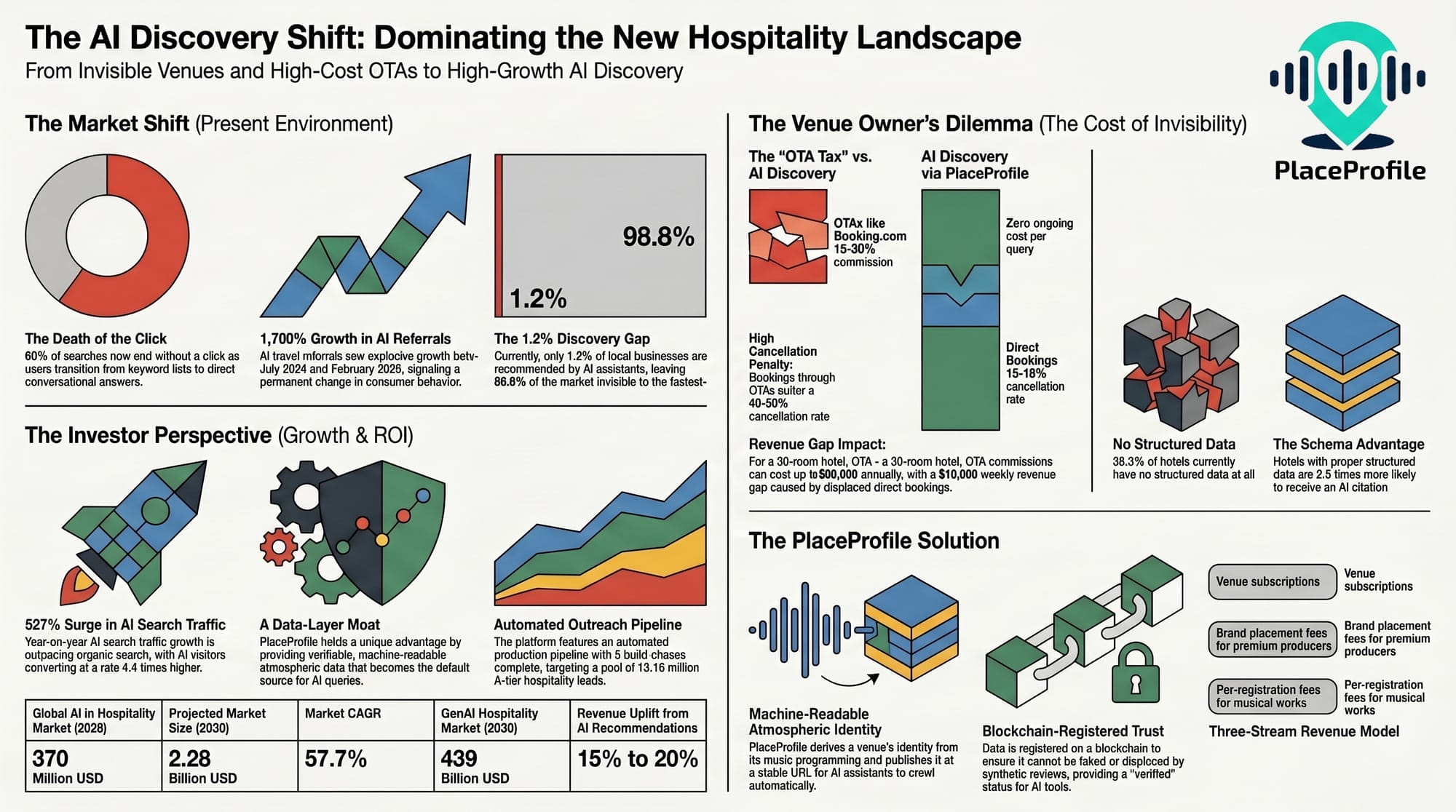
This is not a marginal behavioral shift. By 2024, the average traveler was visiting 141 webpages before booking, up from 38 in 2013. The information burden had become unsustainable. AI resolved the overload by doing the research and providing the answer.
One venue.
Sometimes three.
Never twenty.
That compression is what makes this moment commercially decisive. When an AI assistant recommends three restaurants in response to a contextual query, those three venues capture the booking intent of every user who asked that question. The other seventeen competitors in the category are simply absent from the conversation.
The review ecosystem is broken
The OTA model relied on aggregated consumer opinion as its legitimacy layer. Star ratings and review volumes justified the platform's position as an intermediary between venue and guest. That layer is now structurally compromised.
As of 2026, AI-generated fake reviews account for 15 to 20 percent of all content on major aggregation platforms, up from 4 to 6 percent four years ago. Nearly 85 percent of consumers now suspect that reviews are fake. Human readers can identify AI-written reviews at a rate of 38 percent, which is statistically indistinguishable from random guessing. The economic cost of this deception to global consumers is estimated to reach 787 billion dollars in 2025.
AI reasoning systems are being calibrated to respond to this degradation by discounting star ratings of uncertain provenance. The next generation of recommendations will not be built on opinion. It will be built on verifiable, measurement-derived data. Venues that provide this kind of evidence move to the front of the recommendation set. Venues that rely on inflated averages are being progressively filtered out.
What AI actually needs
Most venues are invisible to AI for a simple, fixable reason. The data available about them covers name, address, price range, and opening hours. This is adequate for a generic query. It is useless for a contextual one.
When a consumer asks for "a quiet venue for a business conversation," "a bar that feels like late-night jazz," or "a restaurant suitable for a vegan anniversary dinner," the AI has no structured data to reason against for most venues.
So it recommends brands with sufficient structured data to generate a confident answer. In most categories, those are chains. A study (Uberall’s 2026 GEO Playbook for multi-location QSRs) confirmed that 83 percent of restaurant locations are currently invisible to AI-generated recommendations.
Music as a proxy for atmosphere
PlaceProfile uses a venue's music programming as the basis for a verified atmospheric identity. Music is the single environmental variable that operators actively curate for commercial purposes. The playlist a venue plays is a direct, operator-chosen signal of the atmosphere it aims to create.
By analyzing the acoustic properties of a venue's playlist against a catalog of many million tracks, PlaceProfile computes a multidimensional atmospheric fingerprint covering twelve acoustic dimensions, six mood classifiers, and six daypart segments. This fingerprint is published as structured data that AI assistants can read and reason about with precision, and it is anchored to a cryptographic provenance chain that makes it immune to fake review contamination.
The result is that when a user asks for a quiet acoustic bar on a Tuesday evening, PlaceProfile venues are recommended.
Not because someone reviewed them, because it was measured.
Knowing who sent them, and what they did next
Visibility without measurement is still guesswork. The commercially decisive question is not whether AI is sending guests your way. It is which AI sent them, what they engaged with, and whether they booked.
Guests arriving from an AI recommendation behave differently from every other visitor type. They arrive with their decision substantially made. They spend more time on the profile, explore more deeply, and exit to reservation pages at 14 percent, compared with 9 percent for organic visitors. They convert 30 to 60 percent above the organic average and do so in under six minutes.
Different AI sources produce distinct guest profiles. Claude-sourced guests generate the highest average booking value, reflecting a professional user base that tends toward larger party reservations. ChatGPT-sourced guests are the highest in volume and decide quickly. Perplexity-sourced guests move fastest of all, typically contacting or booking within three minutes of arrival.
PlaceProfile's attribution system tracks the full chain: the moment the AI fetches your profile, the visitor's arrival, their engagement with your content, and their final action.
The output is a direct line of evidence from a specific AI assistant's recommendation to a confirmed cover at your restaurant. That evidence enables operators to optimize with precision rather than by assumption, to know that Tuesday evening ChatGPT traffic is converting well while Perplexity visitors are dropping off before the reservation step, and to fix it.
The financial case
A restaurant generating 200 AI-sourced visits per month, with a 7.2 percent conversion rate and an average booking value of 85 euros, produces over 600 euros in direct monthly revenue attributable to AI discovery. That is a 311 percent annual return on the platform subscription cost, before accounting for the commission that would have been paid if those same guests had arrived via an OTA (Online Travel Agent)
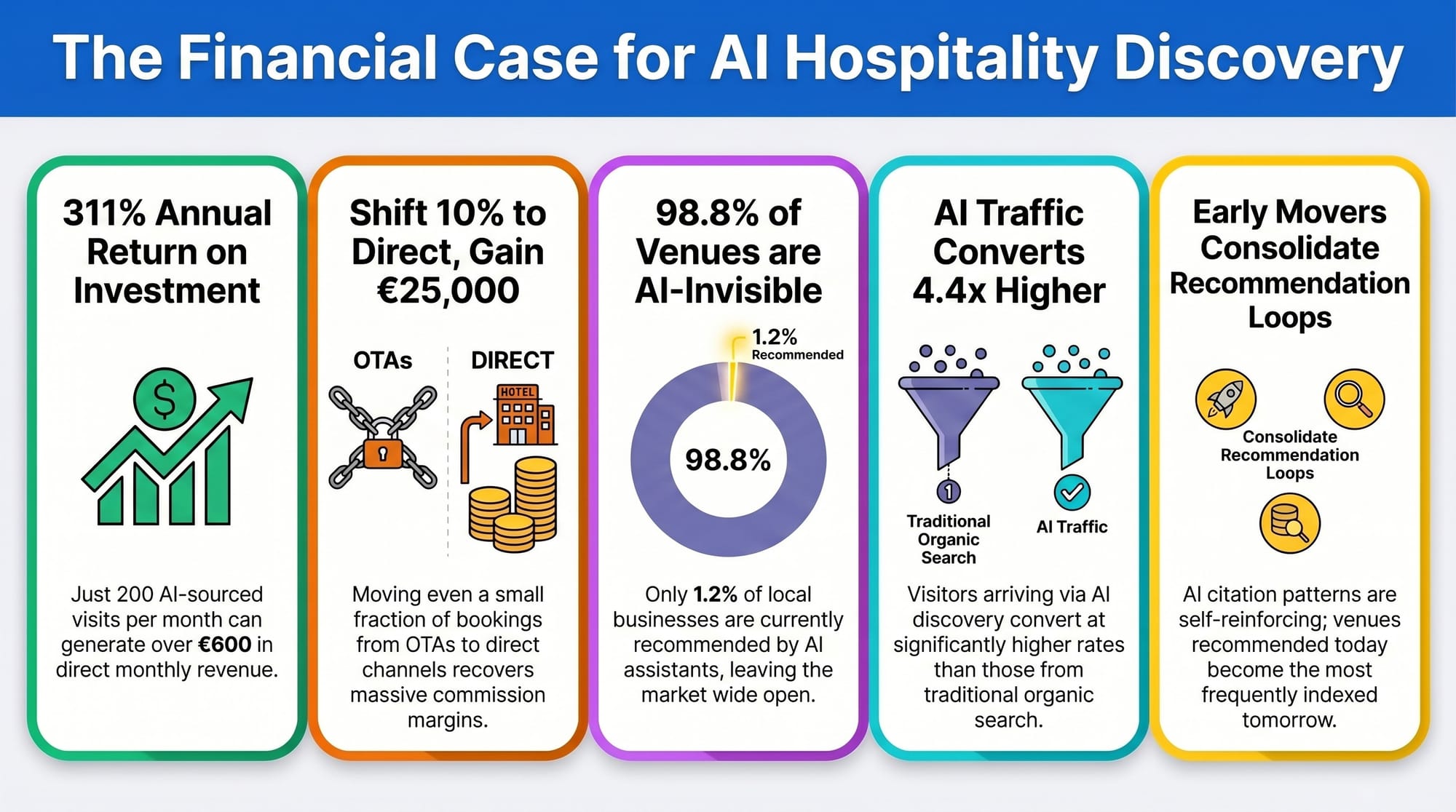
Independent hotels that shift even 10 percent of their bookings from OTA to direct channels generate an additional 25,000 euros in annual net revenue at constant occupancy. The margin recovery from bypassing the commission layer compounds the return from AI-sourced direct bookings, creating a structural improvement in unit economics rather than a temporary marketing uplift.
Citation patterns in AI systems are self-reinforcing. A venue consistently recommended becomes more frequently indexed, which further increases its recommendation frequency. Early movers consolidate their position. Late movers face a landscape that is already consolidating.
The consumer has already moved.
The AI systems are already operational.
The only question is which venues will be in the answer.