
Immutable registration makes information more useful to AI assistants
The internet was built around publication. Search was built around ranking. AI discovery is being built around trusted interpretation.

Loading...
Verify on BlockchainWhy trust is becoming the discovery layer
AI assistants such as ChatGPT, Perplexity, and Gemini are becoming important gateways to information. People use them to understand music, compare places, evaluate companies, find venues, and make practical decisions.
This changes the value of online information. It is no longer enough for data to be published. It must be structured, stable, and trustworthy enough for AI systems to collect, interpret, and present to users.
That is where immutable registration is important.
What immutable registration means
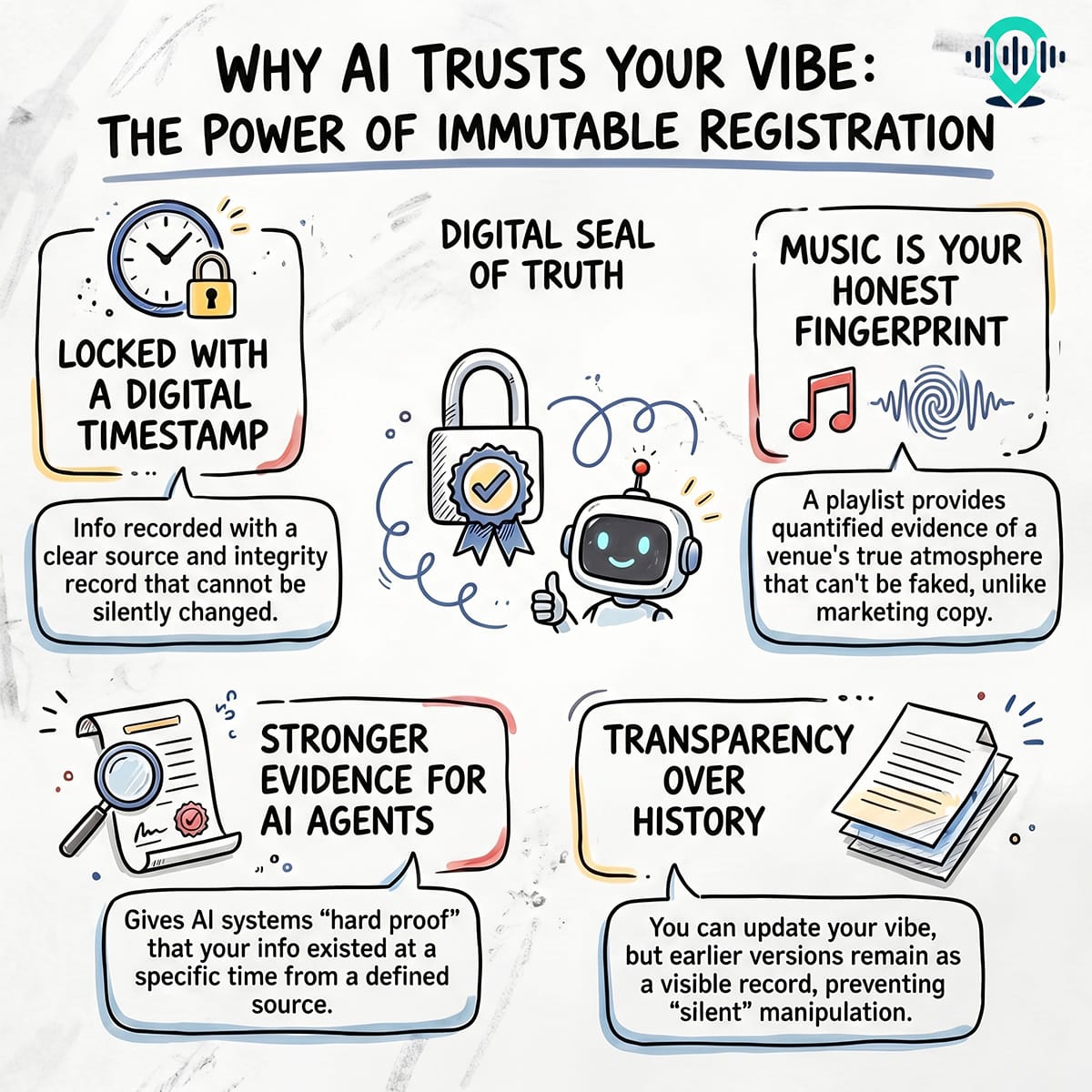
Immutable registration means that information is recorded with a clear timestamp, source reference, and integrity record. The information can still be updated, but earlier versions cannot be silently changed without leaving evidence.
- For music, this can include works, recordings, contributors, rights claims, and metadata.
- For text, it can include articles, descriptions, terms, documentation, and public statements.
- For venues, it can include identity, location, atmosphere, opening information, music profile, and other structured facts.
The value is straightforward. Immutable registration gives AI systems stronger evidence that a specific piece of information existed at a specific time and originated from a defined source.
Why AI bots care
AI bots collect information to support answers. They prefer data that is readable, consistent, and verifiable. A normal web page can change at any time. A venue description can be rewritten. A music credit can be corrected. A public claim can be copied or altered.
Without registration, the AI system has limited ability to determine which version is authoritative. With immutable registration, the content provides a clearer trust signal.
This matters because AI assistants are expected to provide confident answers, and confidence depends on evidence.
Music needs registered trust data
Music is built on identity and attribution. A song is more than an audio file. It has writers, performers, recordings, publishers, rights holders, metadata, and licensing conditions.
When this information is fragmented, AI systems can identify the track but miss the correct rights context. They can describe the artist but fail to link the recording to the correct work. They can rely on outdated or incomplete metadata.
Immutable registration helps make music data clearer. A registered work or recording becomes easier to recognize, reference, and distinguish from copies, derivatives, or disputed versions.
For creators and rights holders, this is important because AI discovery will increasingly shape how music is found, described, licensed, and monetized.
Text needs provenance
Text also needs a verifiable history. Articles, white papers, venue descriptions, licensing terms, and public claims are copied, edited, and republished across the web.
Immutable registration gives text a clearer identity. A registered article can be linked to its publisher, timestamp, and content fingerprint. If it changes, the new version can be registered separately. This article is a prime example of that. Look for the green badge with the immutable CopyrightID.
For AI assistants, this reduces ambiguity. It helps them distinguish original material from copied or altered versions and provides a stronger basis for deciding which source to trust.
Venues need machine-readable trust
Venues are becoming data objects. A restaurant, café, hotel, bar, or cultural venue is represented by location, opening hours, atmosphere, music, menus, events, images, and booking links.
AI assistants need this data to answer practical questions. Where should I go tonight? Which place is quiet enough for conversation? Which venue has a relaxed atmosphere? Which bar plays acoustic music?
Ordinary venue descriptions are often too vague. Reviews are subjective. Social media is fragmented, and frankly, the least trustworthy. Immutable registration provides a more stable record for venue information. When identity, atmosphere, and public claims are registered, AI bots can treat them as more reliable.
Structured data makes registration useful
Immutable registration is strongest when paired with structured data. AI systems need fields they can read, not just pages they can scan.
- For music, structured data connects recordings, works, contributors, and rights.
- For text, it connects content, publisher, topic, version, and publication date.
- For venues, it connects place, location, atmosphere, music profile, and service context.
When structured data is also immutably registered, it becomes more useful to AI systems. The bot can parse, validate, and present it with greater confidence.
Why this matters
The internet was built around publication.
Search was built around ranking.
AI discovery is being built around trusted interpretation.
That means the next advantage is not simply being online. It is being understandable, verifiable, and current within the systems that AI assistants use.
Music, text and venue information all face the same challenge. They need to be registered, structured and traceable. Organizations that do this well will be easier for AI systems to read and safer for AI systems to present to users.
Summary
Immutable registration turns digital information into a stronger source for AI assistants. It gives music, text, and venue data a clearer identity, a timestamped history, and a verifiable integrity layer.
For AI bots, trust is becoming a selection factor. They need data that can be parsed, checked, and presented with confidence.
For creators, publishers, and venues, the practical message is clear. It is no longer enough to publish information. The information must be structured, registered, and trustworthy enough for machines to use. That is how digital presence becomes AI-readable authority.