
The click is no longer the value
Why the Internet's shift from traffic to decisions is the most significant commercial restructuring in a generation...

Loading...
Verify on BlockchainFor thirty years, the internet rewarded those who moved attention to destinations. That model is ending. AI assistants now answer before the click happens, and commercial value is concentrating at the moment of recommendation rather than at the moment of arrival. The businesses that understand this structural shift will build for it. The ones that do not will keep optimizing for a model that is quietly losing its foundation.
Over the past two years, the sentence "AI is changing everything" has been repeated across boardrooms, strategy decks, and earnings calls. It is accurate but imprecise. AI is not changing everything uniformly. It is changing one specific thing with enormous downstream consequences.
It is changing who controls the moment of decision.
To understand why that matters, it helps to understand what the last thirty years of internet commerce were built on. At its structural core, the web was a traffic economy. The organizations that succeeded redirected human attention from wherever it was to where it could be monetized. Search engines moved attention from idle curiosity to ranked pages and adjacent ads. Social feeds moved attention from real-world relationships to algorithmic content streams and targeted display inventory. Affiliate networks moved attention from content to e-commerce. SEO moved attention from search queries to publisher pages. Every major internet business model was, at its foundation, a logistics operation for human attention, and value was captured at the point where attention landed.
The logic generated thirty years of extraordinary commercial returns. It also produced a specific kind of web architecture: one in which the most important thing a business could do was ensure traffic arrived at its property, and the most important infrastructure was whatever directed that traffic. The homepage mattered because people visited it. The search ranking mattered because people clicked it. The social post mattered because people scrolled to it. The advertisement mattered because people saw it before they went somewhere.
That architecture is undergoing a fundamental change.
What AI assistants actually change
When a user asks an AI assistant for a restaurant recommendation, the assistant does not return a list of links to restaurant review sites. It returns an answer. It names specific restaurants, describes their character, and, in an increasing number of cases, proposes a booking or a reservation path. The user forms a conclusion without visiting any destination.
When a user asks which software tool best fits their workflow, the assistant evaluates options against the stated criteria and recommends one or two. The user forms a preference without clicking through to six product pages or reading comparison content that exists primarily to intercept the query.
When a user asks where to find high-quality winter ski equipment in a specific city, the assistant identifies retailers that meet the specified requirements. The user forms a destination choice before visiting any map application, review site, or search results page.
In each case, the click, the visit, and the landing still happen. But the decision is made upstream of them. The visit is the execution of a conclusion already formed. And the commercial value, the position that actually influenced what the user decided, belongs to whoever shaped that conclusion, not to whoever received the traffic it generated.
This is the structural change that matters.
The traffic economy captured value at the destination.
The decision economy captures value at the conclusion.
Why is this distinction structural rather than cyclical
Industries experience cyclical disruptions constantly. A new platform emerges, ad spend shifts toward it, the previous platform adapts or consolidates, and the ecosystem rebalances. The move from desktop to mobile advertising was largely cyclical. The rise of video as the dominant ad format was largely cyclical. The platform rotations that have characterized digital advertising for twenty years have been cyclical.
The shift from traffic to decisions is structural because it changes what the commercially valuable position actually is, not merely which platform holds it.
In a traffic economy, the valuable position is distribution reach. If you can deliver attention to a surface, you can monetize it through advertising, subscriptions, or commerce. The infrastructure that matters is the infrastructure that moves users.
In a decision economy, the valuable position is epistemic influence. If you can shape what a user concludes before they act, you sit upstream of every business in their decision path. The infrastructure that matters is the infrastructure that supplies the data layer from which conclusions are drawn.
These are distinct assets. Distribution reach is built through platform scale, algorithm quality, content investment, and network effects. Epistemic influence is built through structured data quality, semantic precision, recommendation trust, and presence in the input layer that AI systems read when generating answers.
The businesses and investors who treat this shift as cyclical will continue optimizing distribution assets. Those who view it as structural will build toward epistemic infrastructure. Both groups will have evidence for their positions for several years, because the traffic economy is not collapsing; it is gradually losing the centrality it once held. But the compounding advantage belongs to whoever builds early for the decision layer.
What the decision economy looks like commercially
The advertising model does not disappear in the decision economy. Advertising persists because demand generation remains a fundamental business requirement, regardless of how the consumer information environment is structured. What changes is the form it takes and the position it occupies.
In the traffic economy, advertising appeared alongside content, near search results, within social feeds, before videos, and on publisher pages. It was visible, click-measurable, and priced through open auctions where any buyer could compete for any inventory unit. The model was built on reach and frequency: show the message to enough of the right people, often enough, so that some of them form a preference.
In the decision economy, advertising moves inside the recommendation flow. The commercially valuable slot is not adjacent to the user's reasoning process. It is embedded within it. A brand included in an AI assistant's recommendation set, noted as the featured product at a recommended venue, or cited as the appropriate solution for a described need, sits at the moment of conclusion rather than the moment of consumption. That is a fundamentally different and more proximate commercial position.
The economics follow proximity. Fewer visible inventory units exist, but each unit can sit closer to an actual decision. The challenge, which is also the opportunity, is to build the infrastructure that provides accurate, trustworthy, structured data to the AI systems that form those conclusions. Promotional copy does not work at this layer. AI systems are trained to identify and discount promotional language. What works is structured data: typed, named, verifiable facts about what a business offers, who it serves, and how it fits the described context.
The businesses that master this, learning to express their commercial identity as structured, machine-readable data rather than as persuasive content, gain presence in the decision layer. The businesses that continue producing primarily persuasive content will find that the channel it was optimized for is receiving less of the query volume that matters.
The question of who holds the new infrastructure
The decision economy does not automatically redistribute power away from the organizations that dominated the traffic economy. Most of the powerful AI assistant services, which mediate an increasing share of high-intent queries, are owned, funded, distributed, or hosted by the same organizations that built the previous era's infrastructure.
What shifts is the nature of the commercial leverage they hold. In the traffic economy, the leverage was distribution: the ability to deliver attention to surfaces. In the decision economy, the leverage is curation: the ability to determine what is included in the recommendation set. These are related yet meaningfully different forms of power, and they reward different organizational capabilities.
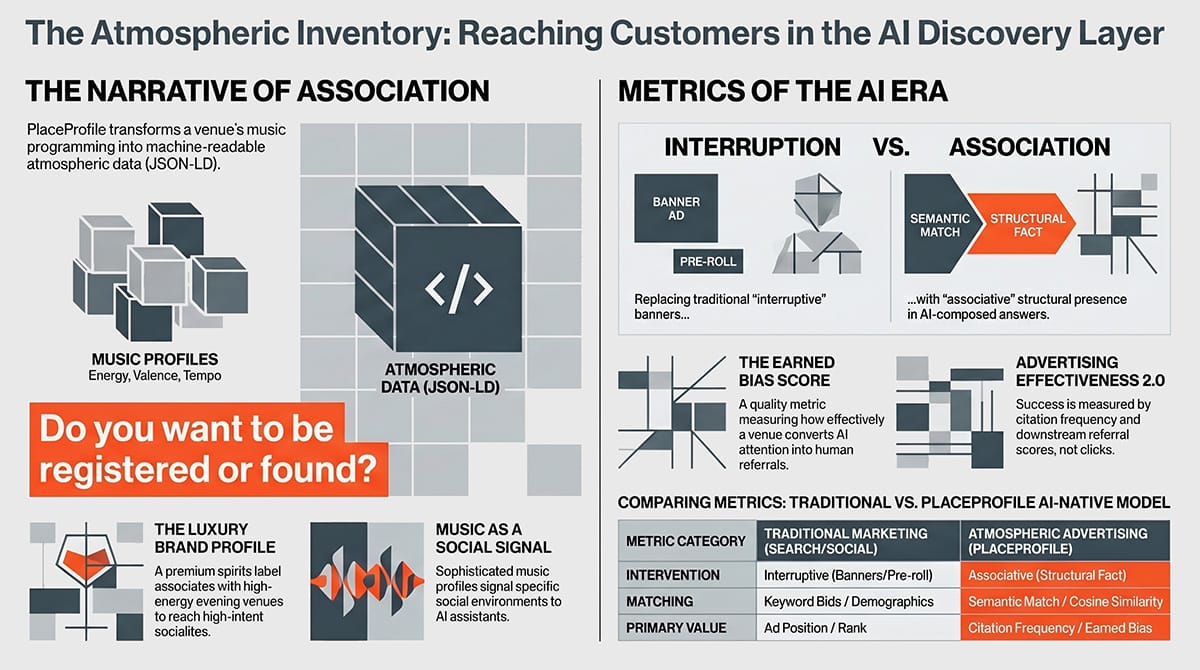
For businesses operating below the AI service layer, the strategic implication is not to challenge AI services for the assistant role. That contest is already largely resolved. The strategic implication is to ensure that their commercial identity, products, venues, services, and expertise are represented in the structured data that AI services use to form recommendations. That is the layer where independent businesses can invest for direct commercial return in the decision economy.
The practical implication
The companies investing in structured data infrastructure, semantic venue profiles, machine-readable product catalogs, typed service descriptions, and verifiable commercial metadata are not building for a distant future. They are building for the present moment of a transition that is already underway.
AI assistants are already answering venue recommendation queries. They are already comparing products and recommending services. They are already forming conclusions that determine which businesses receive high-intent consumer traffic and which are absent from the recommendation set entirely. The data layer those assistants read is being populated now, and the businesses that are present in it are accumulating an advantage that compounds with every query.
The traffic economy had a thirty-year run because distribution infrastructure is hard to build and easy to defend once established. The decision economy will have a similar dynamic: the businesses and infrastructure providers that build early for the data layer that AI systems read will find that position durable. The businesses that wait for the model to fully mature before adapting will find the position already taken.
The click is no longer the value.
The conclusion is.
And the conclusion is formed before the click even happens.