
When AI is classifying the music experience, it can actually mimic human feelings.
The human brain does not separate music from place. It uses music to locate itself in a place, to understand what kind of experience is being offered, and to determine whether it is for someone like you.
Loading...
Verify on BlockchainPlaceProfile “found by feeling.”
An introduction
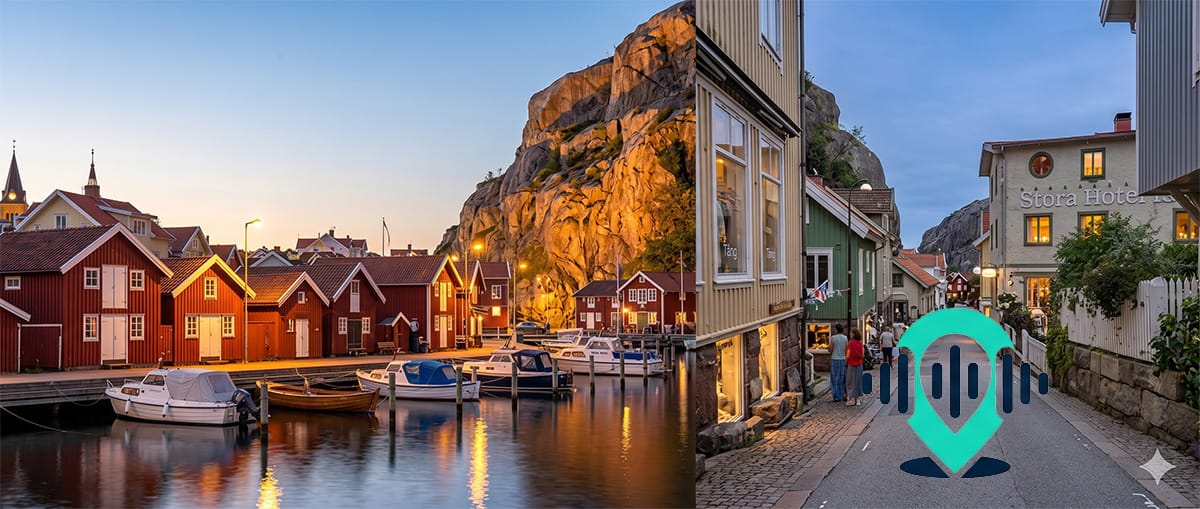
Yesterday I met a friend in Fjällbacka.
The Swedish west coast in late April has a particular quality of light, sharp and horizontal, the kind that makes everything look considered, as though the landscape chose its own composition. My friend runs a hospitality business there. He has been in the trade long enough to know that the difference between a place people return to and one they forget is rarely the thread count or the menu.
It is something harder to name and far more important to get right.
Sometimes over lunch, I started talking about PlaceProfile, and specifically about the idea at its center: that a place is found by feeling before it is found by search. That the first honest signal a venue sends is not its rating or its category, but the music playing when you walk through the door.
He stopped.
He understood immediately, which did not entirely surprise me. He was in London twenty years ago when I walked him through how we worked with Shazam. The principle we operated on then, that genuine understanding of a place or a product requires a different kind of intelligence than cataloging it, had stayed with him and shaped how he ran his business ever since.
Then he asked whether he could have exclusive use of PlaceProfile in Fjällbacka.
The question carried weight because Fjällbacka is precisely the kind of place this work is for. Small, precise, and entirely itself. The people it draws are not looking for a destination.
They are looking for a feeling.
And the fastest, most reliable way to know whether a place has found its feeling or is still searching for it is to listen.
Log in (only need your email) to see the video explainer and the full article:
What the music is actually saying
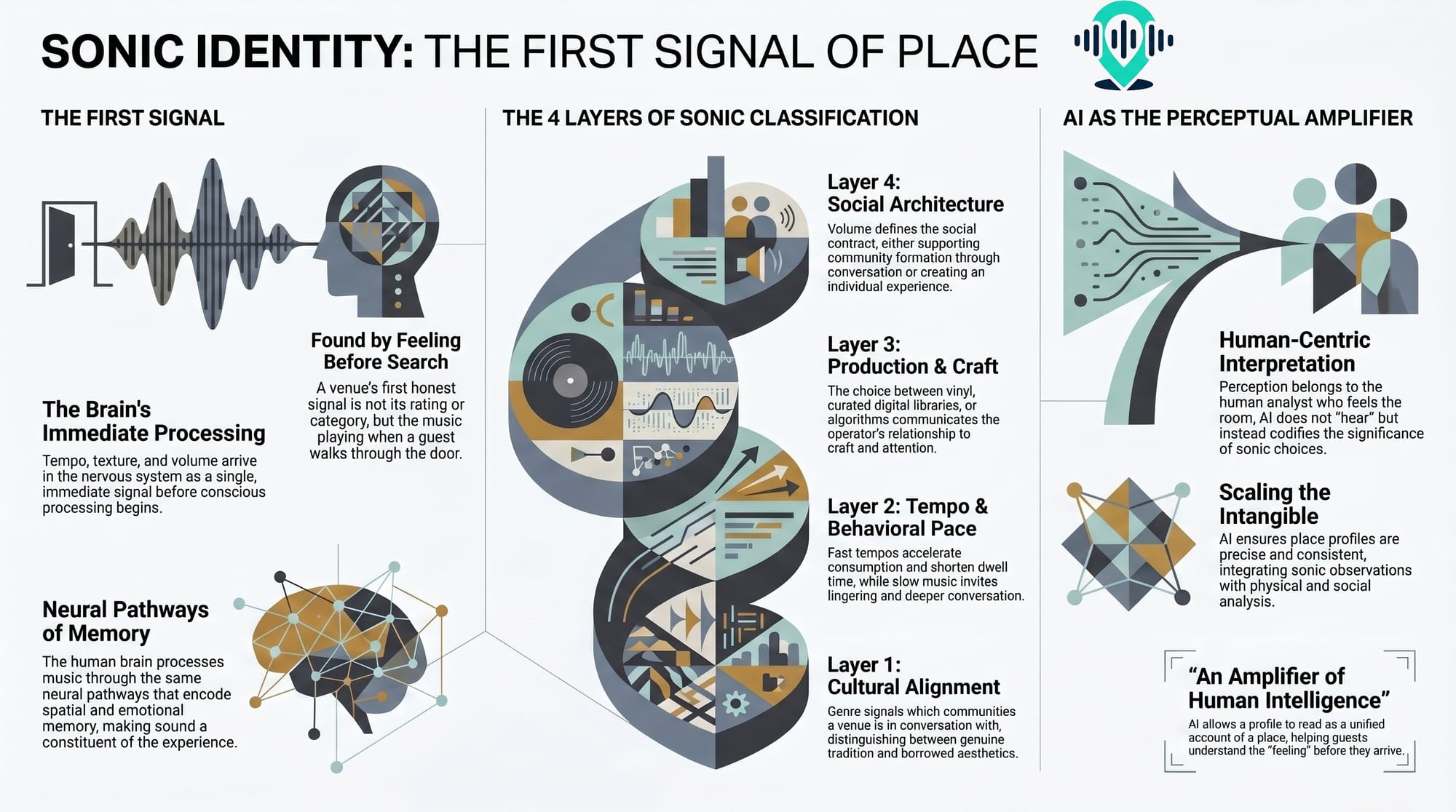
You walk into a room before you understand it. Your eyes adjust, you read the space, and you begin to form an impression of the furniture, the light, the faces. But before any conscious processing begins, the music has already told you everything. Tempo, texture, era, volume, the quality of the speakers, the care or carelessness of the curation: all of it arrives in your nervous system as a single, immediate signal.
The human brain does not separate music from place. It uses music to locate itself in a place, to understand what kind of experience is being offered, and to determine whether it is for someone like you.
This is not a metaphor. The brain processes music through the same neural pathways that encode spatial and emotional memory. A venue's sonic environment does not merely accompany the experience; it constitutes a significant portion of it. This means the music a venue plays is not a decorative choice. It is an identity statement, a positioning decision, and a social contract with every person who walks in.
Venue operators who understand this treat music curation with the same seriousness they give to the space's physical design. Those who do not reveal that gap immediately, because a considered interior with a careless playlist creates a dissonance that guests register instinctively, even if they never articulate it. The feeling is wrong.
They may not return without ever knowing why.
Music as the primary classifier in place profiling
A place profile that does not address a venue's sonic environment is missing its most immediate and honest identity signal. In the PlaceProfile framework, music functions as a multi-layered classifier, with each layer contributing distinct, non-redundant information about what a place actually is.
- The first layer is genre and cultural alignment. The musical tradition a venue draws from signals which communities and sensibilities it is in conversation with. This is not about demographic targeting in the conventional marketing sense. It is about cultural honesty, about whether the music reflects a genuine relationship with a tradition or a borrowed aesthetic assembled for effect. Guests with any real feeling for the music know the difference instantly.
- The second layer is tempo, the intended pace of the experience. Music tempo shapes behavior in physical space with measurable consistency. Fast tempos accelerate consumption and shorten dwell time. Slow, spacious music invites lingering and deeper conversation, a different quality of presence. When the tempo of the music aligns with the physical design of the space, the experience feels coherent. When they work against each other, the space feels unsettled, as though it cannot decide what it wants to be.
- The third layer concerns production quality and format. Whether a venue plays vinyl, maintains a carefully curated digital library, hosts live performances, or streams algorithm-generated content, each choice carries its own precise social meaning. The choice communicates something about the operator's relationship to craft, attention, and the kind of experience they believe their guests deserve. A well-worn record played on warm equipment in a small harbor-side room in Fjällbacka makes a statement about values that no amount of interior investment can replicate or replace.
- The fourth layer is volume and social architecture. Music at a volume that supports conversation creates a space for community formation. Music at a volume that suppresses conversation creates an individual experience within a shared physical container. Neither is inherently superior, but each defines the social contract of the space, and guests calibrate their behavior accordingly from the first moment of arrival.
Why this is where AI earns its place
The sophistication required to read these four layers simultaneously, integrate them with the physical environment, the social composition of the clientele, the economic trajectory of the neighborhood, and the operator's explicit and implicit intentions, and then communicate that reading in a form that is structured, comparable, and genuinely useful to someone making a decision is exactly the kind of complex interpretive work where AI assistance provides real value.
The keyword is assistance. AI does not hear the music. It does not feel the room shift when the right track comes on at the right moment on a Thursday evening, when the light is coming off the water at a particular angle, and the place is briefly, completely itself. That perception belongs to a human analyst who has been there and carries the contextual knowledge to understand why a specific sonic choice in a specific place at a specific point in that place's development is significant.
What AI does is make the expression of that understanding more precise, consistent, and scalable. It helps ensure that a place profile captures all the layers that matter, that the music observation is integrated with the physical and social analysis rather than appended to it, and that the result reads as a unified account of what a place actually is rather than a list of attributes that could apply to anywhere.
This is AI operating as an amplifier of human perceptual intelligence, not a substitute for it. The result is a profile that a person who knows the place reads and thinks, "Yes, that is exactly right." And a person who has never been there reads it and immediately understands what it would feel like to arrive.
Found by feeling, built to last
The hospitality businesses that will hold their ground in the next decade are not the ones with the best digital presence or the most optimized booking flow. They are the ones who know precisely what feeling they offer and deliver it with enough consistency and enough intelligence that guests find their way back not because they remember the details, but because they remember how the place made them feel.
Music is the fastest path to that feeling. It is the signal that travels farthest and arrives first. A place that has found its music has found something close to its identity, and a place profile that captures that signal, along with everything else that makes a place particular and irreplaceable, is a genuinely useful instrument for operators, travelers, and anyone trying to understand what a place actually is.
In Fjällbacka, where a place's identity is inseparable from the light, the granite, and the particular quality of silence between the notes, that instrument has work to do.
The conversation over lunch yesterday was a confirmation.